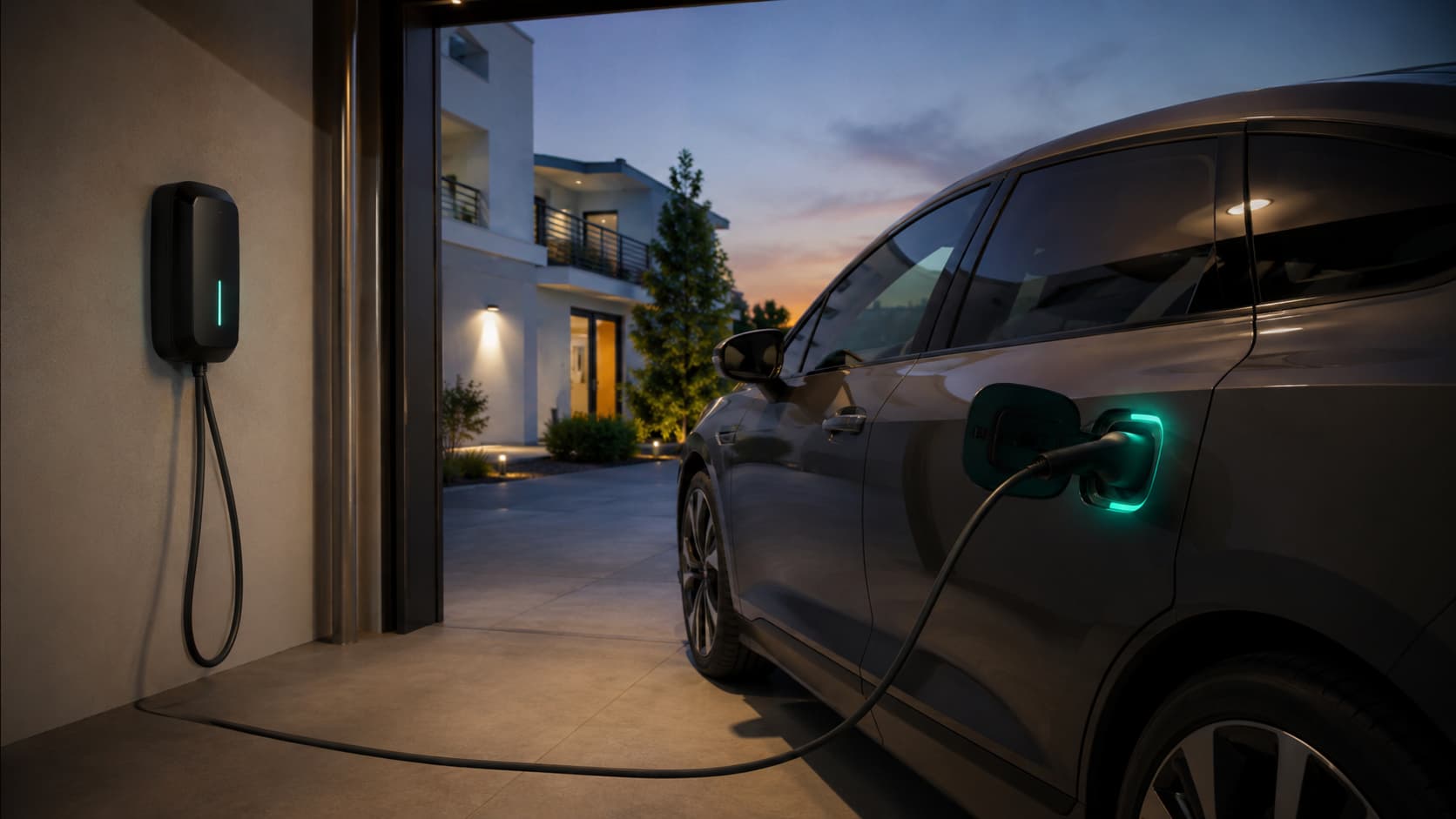
Charging an electric car at home costs less than fuelling a petrol car. But how much less depends on three things: your car's energy consumption, how far you drive each year, and what you pay per kWh.
This guide gives you the formula, worked examples and a country-by-country comparison. You will also see how much you can save by switching to an off-peak overnight tariff.
How to Calculate the Cost
The basic formula is simple:
Cost per charge = battery capacity (kWh) × electricity price (£/kWh)
Most drivers do not charge from empty to full. A typical top-up goes from around 20% to 80%. Many manufacturers offer a charge limit setting for this reason, and it is widely recommended to help extend battery life. For a partial charge:
Cost = battery capacity × (target % minus current %) × electricity price
| Car / battery size | Full charge at £0.25/kWh | 20% to 80% top-up |
|---|---|---|
| Small EV, 40 kWh (e.g. Renault Zoe) | £10.00 | £6.00 |
| Mid-size EV, 60 kWh (e.g. VW ID.4) | £15.00 | £9.00 |
| Large EV, 77 kWh (e.g. Tesla Model Y) | £19.25 | £11.55 |
| Long-range EV, 100 kWh (e.g. Tesla Model S) | £25.00 | £15.00 |
These figures use £0.25/kWh, which is in line with the Ofgem unit rate for Q2 2026. Check your energy bill to find your actual rate.
Monthly and Annual Cost
To work out your monthly charging cost, you need two numbers: your annual mileage and your car's consumption in kWh per 100 km.
Monthly energy (kWh) = (annual km ÷ 12) × (kWh per 100 km ÷ 100)
Monthly cost = monthly energy × electricity price
Example: a driver covering 15,000 km per year in a mid-size EV using 18 kWh/100 km.
- Monthly distance: 15,000 ÷ 12 = 1,250 km
- Monthly energy: 1,250 × 0.18 = 225 kWh
- Monthly cost: 225 × £0.25 = £56
- Annual cost: £56 × 12 = £675
| Annual mileage | Energy used (18 kWh/100 km) | Monthly cost at £0.25/kWh | Annual cost |
|---|---|---|---|
| 8,000 km/year | 1,200 kWh/year | £25/month | £300/year |
| 15,000 km/year | 2,700 kWh/year | £56/month | £675/year |
| 25,000 km/year | 4,500 kWh/year | £94/month | £1,125/year |
Calculate your exact monthly charging cost
Enter your car's battery size, annual mileage and electricity tariff for a full breakdown.
Open EV Charging Cost CalculatorWhich Charger Do You Need?
Charger speed does not affect cost. You pay for the same number of kWh whether it takes 5 hours or 16 hours. Speed only affects whether overnight charging is practical for your battery size.
| Charger type | Power | Range added per hour | Time for 60 kWh (20% to 80%) |
|---|---|---|---|
| 3-pin plug (Mode 2) | 2.3 kW | ~14 km/hour | ~16 hours |
| 7 kW wallbox (Mode 3) | 7 kW | ~43 km/hour | ~5 hours |
| 11 kW wallbox (three-phase) | 11 kW | ~67 km/hour | ~3.3 hours |
| 22 kW wallbox (three-phase) | 22 kW* | ~130 km/hour* | ~1.6 hours* |
* The 22 kW figure requires both a three-phase supply and a car with a 22 kW onboard AC charger. Most EVs cap AC charging at 7.4 kW or 11 kW. A 22 kW wallbox will charge those cars no faster than an 11 kW one. Check your car's spec before buying a wallbox rated above 11 kW.
For most homes, a 7 kW wallbox is enough. It handles a 60 kWh battery overnight in around 5 hours and works on a standard single-phase supply. In the UK, supply and installation typically costs £800 to £1,500 for a straightforward job (2026).
Off-Peak Tariffs
Several energy suppliers offer EV-specific tariffs with low overnight rates, typically from 02:00 to 06:00. The trade-off is a slightly higher daytime rate, but for most EV drivers the overnight saving more than compensates.
| Tariff type | Typical rate | Annual cost (15,000 km) |
|---|---|---|
| Standard flat rate (UK) | £0.25/kWh | £675/year |
| EV off-peak overnight tariff | £0.10/kWh | £270/year |
| Economy 7 overnight rate | £0.12/kWh | £324/year |
| Public rapid charger (avg) | £0.75/kWh | £2,025/year |
Switching from a standard tariff to an EV overnight rate saves around £405 per year for the driver in this example. Over five years that is £2,025, which is often more than the cost of the wallbox.
EV vs Petrol: Cost Per km
The clearest comparison is cost per 100 km. It normalises for different driving distances and car sizes.
| Fuel type | Consumption | Fuel price | Cost per 100 km |
|---|---|---|---|
| Petrol car (avg) | 7 L/100 km | £1.45/litre | £10.15 |
| Diesel car (avg) | 5.5 L/100 km | £1.50/litre | £8.25 |
| EV (standard home tariff) | 18 kWh/100 km | £0.25/kWh | £4.50 |
| EV (off-peak home tariff) | 18 kWh/100 km | £0.10/kWh | £1.80 |
| EV (public rapid charger) | 18 kWh/100 km | £0.75/kWh | £13.50 |
On a standard home tariff, an EV costs about £4.50 per 100 km compared to £10.15 for a petrol car. On an off-peak tariff, it drops to £1.80.
The one scenario where an EV costs more than petrol is if you rely mainly on public rapid chargers. At £0.75/kWh, the cost per 100 km exceeds even a petrol car. Home charging makes the economics work.
Cost by Country
Electricity prices vary. Here is the same 15,000 km/year example using approximate residential rates in each country.
| Country | Approx. residential rate | Annual charging cost (15,000 km) |
|---|---|---|
| Norway | NOK 0.80–1.50/kWh spot* | ~£180–350/year* |
| France | €0.25/kWh | ~€675/year |
| Germany | €0.38/kWh | ~€1,026/year |
| United Kingdom | £0.25/kWh | ~£675/year |
| Ireland | €0.42/kWh | ~€1,134/year |
| United States (avg) | $0.17/kWh | ~$459/year |
| Australia (avg) | A$0.32/kWh | ~A$864/year |
* Norway's spot electricity price can be low, but the total bill includes a grid tariff (nettleie) and consumption taxes that add roughly NOK 0.50–1.00/kWh on top. The figures above use the spot rate only and will understate the real cost for most Norwegian consumers.
German and Irish drivers pay around 50 to 70% more per year than UK or French drivers at current rates. That makes an off-peak tariff even more valuable in those markets.
Calculate Your Exact Cost
The numbers above are based on typical values. Your actual cost depends on your car, your driving habits and your tariff. Use the calculator below to enter your own numbers.