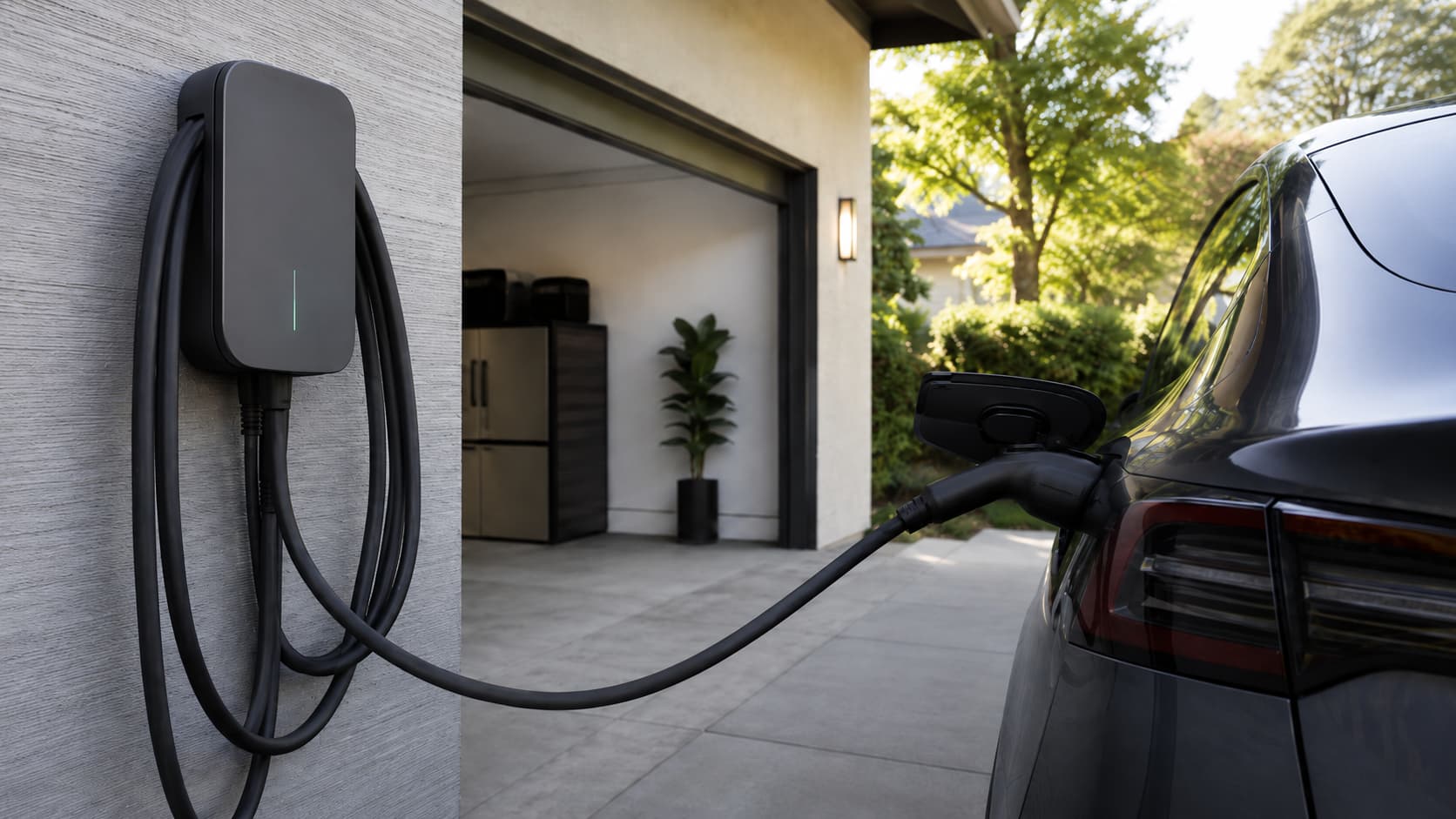
A home EV charger lets you charge an electric car at home, usually at a lower rate than public charging, depending on your electricity price and charging habits.
You charge your electric vehicle at public stations and pay whatever rate the network charges per kWh. That rate is often two to three times what you pay for electricity at home. A home wallbox costs money to install, but shifts most of your charging to the cheaper home tariff. Whether those savings ever exceed the installation cost, and over what period, depends on a handful of variables specific to your situation.
This article works through each factor, shows typical payback ranges across different driver profiles, and tells you when the numbers work and when they do not.
What drives payback
The payback calculation for a home EV charger comes down to a single ratio: net installation cost divided by annual saving. The annual saving is the volume of electricity you shift from public to home charging each year, multiplied by the price gap between those two sources.
If you drive 15,000 km per year in a vehicle drawing 20 kWh per 100 km, your annual energy need is 3,000 kWh. If 70 percent of that shifts from public to home charging, you move 2,100 kWh per year from the expensive public tariff to your cheaper home rate. At a rate gap of 0.20 per kWh, that is 420 in annual savings. At a gap of 0.30 per kWh, it is 630. Divide the net installation cost by that figure, and you have your payback period in years.
Four variables move that number the most: the gap between home and public rates, how far you drive each year, your vehicle's efficiency in kWh per 100 km, and how much of your charging shifts to home.
Installation cost
A 7 kW single-phase wallbox with a straightforward installation typically costs between 500 and 1,500 in total, depending on your country, charger model, and home's existing electrical setup. If your home needs a panel upgrade, three-phase wiring, or a longer cable run, costs climb toward 2,500 or higher.
Getting at least two installer quotes is worth the effort before committing. Prices for the same job vary significantly between providers, and some installers handle grant applications on your behalf, which simplifies the process.
Grants and incentives
Grants, rebates and tax incentives vary by country, region, utility provider and property type. Where available, they often reduce the net cost significantly. Eligibility conditions and amounts change regularly, so check your national energy agency or government website before booking an installer.
Applying before installation is often a condition of eligibility. In markets where pre-approval is required, booking an installer without checking grant availability first means missing a meaningful cost reduction. The net cost after grants is what matters for your payback calculation, not the gross installation price.
The charging rate gap
The price gap between public charging and your home electricity rate is the biggest driver of payback speed. The wider the gap, the faster savings accumulate.
Public charging is often more expensive than home charging, especially for fast charging, but prices vary by operator, location and subscription plan. In areas where the gap is large, each kWh shifted from public to home generates a meaningful annual saving. Where public charging is cheap or subsidised, the financial case is weaker.
Time-of-use tariffs, which offer lower rates during off-peak hours, widen the gap further. EV drivers on these tariffs who charge overnight at off-peak rates often see the most favourable payback periods. If public charging in your area is already cheap, or if you regularly top up at free destination chargers at workplaces or supermarkets, the effective gap narrows and payback extends.
Annual mileage and vehicle efficiency
Annual mileage determines the volume of electricity that moves from public to home charging each year. More kilometres driven means more potential saving per year, which shortens payback. Vehicle efficiency also matters: a compact EV drawing 14 kWh per 100 km shifts far less energy than a larger vehicle drawing 26 kWh per 100 km over the same distance. Both benefit from home charging, but the annual saving scales with total consumption.
To estimate your annual home-charged kWh, multiply your annual mileage by your vehicle's kWh per 100 km figure (found in the owner's manual or manufacturer specifications), divide by 100 to get total annual kWh, then multiply by your expected home charging proportion. That is the volume figure for your saving calculation.
Typical payback scenarios
In many cases, payback may fall somewhere between 3 and 8 years, but the result depends on installation cost, public charging prices, home electricity rates and annual mileage. The table below illustrates how these factors interact across different driver profiles, assuming a net installation cost of around 1,000 to 1,200 in local currency. Treat the figures as a starting point and apply your own numbers for a more accurate estimate.
| Driver profile | Rate gap (home vs public) | Annual km | Approx. payback |
|---|---|---|---|
| Low mileage, mixed charging sources | 0.15/kWh | 8,000 | 10–15 years |
| Average commuter, moderate rate gap | 0.20/kWh | 15,000 | 4–6 years |
| Higher mileage, larger rate gap | 0.30/kWh | 22,000 | 2–3 years |
| Off-peak tariff, mostly home charging | 0.35/kWh | 18,000 | 1–2 years |
Proportion charged at home
Not all your charging will shift to home. Long trips require public fast charging, and some drivers regularly top up at work or at destination chargers. For a typical commuter who drives daily and parks at home overnight, 65 to 80 percent home charging is realistic once a wallbox is installed. Business travellers or drivers who make frequent long journeys often sit lower, at 40 to 60 percent.
Overestimating the home charging proportion is one of the most common reasons payback calculations look better on paper than they do in practice. A conservative estimate leads to a more reliable projection.
Maintenance and charger lifetime
Most home EV chargers last 10 to 15 years under normal residential conditions. Annual maintenance is often low, but inspection, repairs, replacement parts or electrical work may affect long-term savings. Budget a maintenance provision when projecting lifetime cost against lifetime saving.
Many wallboxes include a 3 to 5 year manufacturer warranty. Out-of-warranty costs vary significantly by model and market, and are worth factoring into any long-term projection.
When a home charger does not pay back
The financial case is weak or absent in these situations:
- Low annual mileage. At 8,000 km per year or fewer, annual savings are small regardless of the rate gap. Payback may extend beyond the charger's useful lifetime.
- Free or subsidised workplace charging. If most of your daily charging is free elsewhere, the saving from shifting to home is minimal.
- Home rate close to public rate. In markets where fast charging is regulated and cheap, or where home electricity is particularly expensive, the gap narrows and annual savings shrink accordingly.
- Short vehicle ownership period. If you plan to sell the vehicle within two years, payback may not occur before the car leaves.
- No private parking. Without dedicated off-street parking and a dedicated circuit, installation is often not possible or is prohibitively expensive.
Common mistakes
- Comparing only rapid charger prices. Many drivers also top up at slower destination chargers at hotels, supermarkets, and workplaces, often for free or at a reduced rate. Basing the calculation on rapid charger prices alone overstates the annual saving.
- Assuming all charging moves to home. Road trips and occasional top-ups mean a portion of charging always stays public. An estimate of 65 to 75 percent home charging is more realistic than 90 or 100 percent for most drivers.
- Not checking grant eligibility before booking. Many schemes require pre-approval. Skipping this step means missing a significant cost reduction that changes the entire payback timeline.
- Staying on a flat-rate electricity tariff. A home charger delivers its best return when paired with a time-of-use tariff offering cheap overnight rates. Remaining on a standard tariff and charging during peak hours leaves a substantial portion of the potential saving unrealised.
- Ignoring charger lifetime in long projections. A 15-year projection should include a small annual maintenance provision and account for the possibility that the charger will need replacement before the end of that period.
How to check your own payback in five steps
Before getting an installation quote, gather these five inputs:
- Net installation cost. Get at least two quotes. Confirm whether each includes all electrical work and ask whether the installer handles grant applications. Subtract any confirmed grant from the total to get your net cost.
- Public charging rate. Note the per-kWh rate at the stations you visit most often. If you split between rapid chargers and slower destination chargers, weight the average accordingly rather than using only the highest rate.
- Home electricity rate. If you are on a time-of-use tariff, note the off-peak rate. That is the rate that applies to overnight EV charging, and it is the figure to compare against public charging costs.
- Annual mileage and vehicle efficiency. Your vehicle's kWh per 100 km figure is in the owner's manual or on the manufacturer's website. Multiply by your annual km and divide by 100 to get total annual kWh needed.
- Expected home charging proportion. Estimate what share of your current charging will realistically shift to home. For most household drivers, 65 to 75 percent is a reasonable starting estimate.
Divide the net installation cost by your estimated annual saving to get payback in years. The EV Charger Payback Calculator does this automatically, with inflation adjustment and a year-by-year cumulative return breakdown.
Calculate your EV charger payback
Enter your installation cost, home and public charging rates, annual mileage, and vehicle efficiency to get your payback period and lifetime net return.
Open EV Charger Payback Calculator →In many cases, payback may fall somewhere between 3 and 8 years, but the result depends on installation cost, public charging prices, home electricity rates and annual mileage. Running your own numbers before committing to an installer takes about five minutes and gives you a clearer picture of whether the investment makes sense for your situation.