Getting your roof area wrong costs money in two directions: order too little and the job stalls while you wait for a matching delivery, order too much and you pay for materials that sit in your garage. Either way, the fix is a correct calculation before you buy.
This guide walks through every roof type with the exact formulas used by roofing contractors. Whether you are replacing tiles on a simple gable, pricing a full re-roof on a hip roof, or planning solar panels, the method is the same.
Why Getting the Area Right Matters
Roofing materials are sold by coverage area: per m², per square (100 ft²) or per bundle. A 10% error on a 150 m² roof means 15 m² of missing material, which can be a full pallet. Most common reasons people get it wrong:
- Measuring the footprint (ground area) instead of the actual roof surface
- Forgetting that a pitched roof has more surface than the floor below it
- Not accounting for overhangs (eaves and verges)
- Skipping waste allowance for cuts around chimneys, valleys and hips
Flat Roofs
Flat roofs are the simplest case. Measure the footprint and add the overhangs.
Roof area = (length + eave overhang × 2) × (width + eave overhang × 2)
Example: House footprint 10 m × 8 m, overhang 0.3 m on all sides:
(10 + 0.6) × (8 + 0.6) = 10.6 × 8.6 = 91.2 m²
Pitched Roofs & the Slope Factor
A pitched (gable) roof has two rectangular planes meeting at the ridge. The key variable is pitch: the angle of the roof expressed as rise over run, or in degrees.
The slope factor
The slope factor converts the footprint of one roof plane into its actual surface area.
Slope factor = √(rise² + run²) ÷ run
Or more directly: Slope factor = 1 ÷ cos(pitch angle)
| Pitch (degrees) | Rise:Run (approx.) | Slope factor |
|---|---|---|
| 15° | 3:12 | 1.035 |
| 20° | 4:12 | 1.064 |
| 25° | 5:12 | 1.083 |
| 30° | 6:12 | 1.155 |
| 35° | 8:12 | 1.221 |
| 40° | 10:12 | 1.305 |
| 45° | 12:12 | 1.414 |
Gable roof formula
Roof surface area = footprint area × slope factor
Example: House 10 m × 8 m, pitch 30°, overhang 0.3 m:
- Footprint with overhangs: 10.6 × 8.6 = 91.2 m²
- Slope factor at 30°: 1.155
- Roof surface: 91.2 × 1.155 = 105.3 m²
Calculate your roof area instantly
Enter your dimensions and pitch. Get roof surface area, material quantities and waste estimate in metric or imperial.
Open Roof Area CalculatorHip Roofs
A hip roof has four sloping planes: two triangular ends and two trapezoidal sides. It is more complex to measure but the principle is the same: calculate each plane separately and add them together.
Breaking down a hip roof
- Two trapezoidal sides: the long sides of the roof
- Two triangular ends: the shorter ends that taper to the ridge
For each trapezoidal plane:
Area = ((ridge length + eave length) ÷ 2) × rafter length
For each triangular end plane:
Area = (eave width ÷ 2) × rafter length
Complex & Multi-Plane Roofs
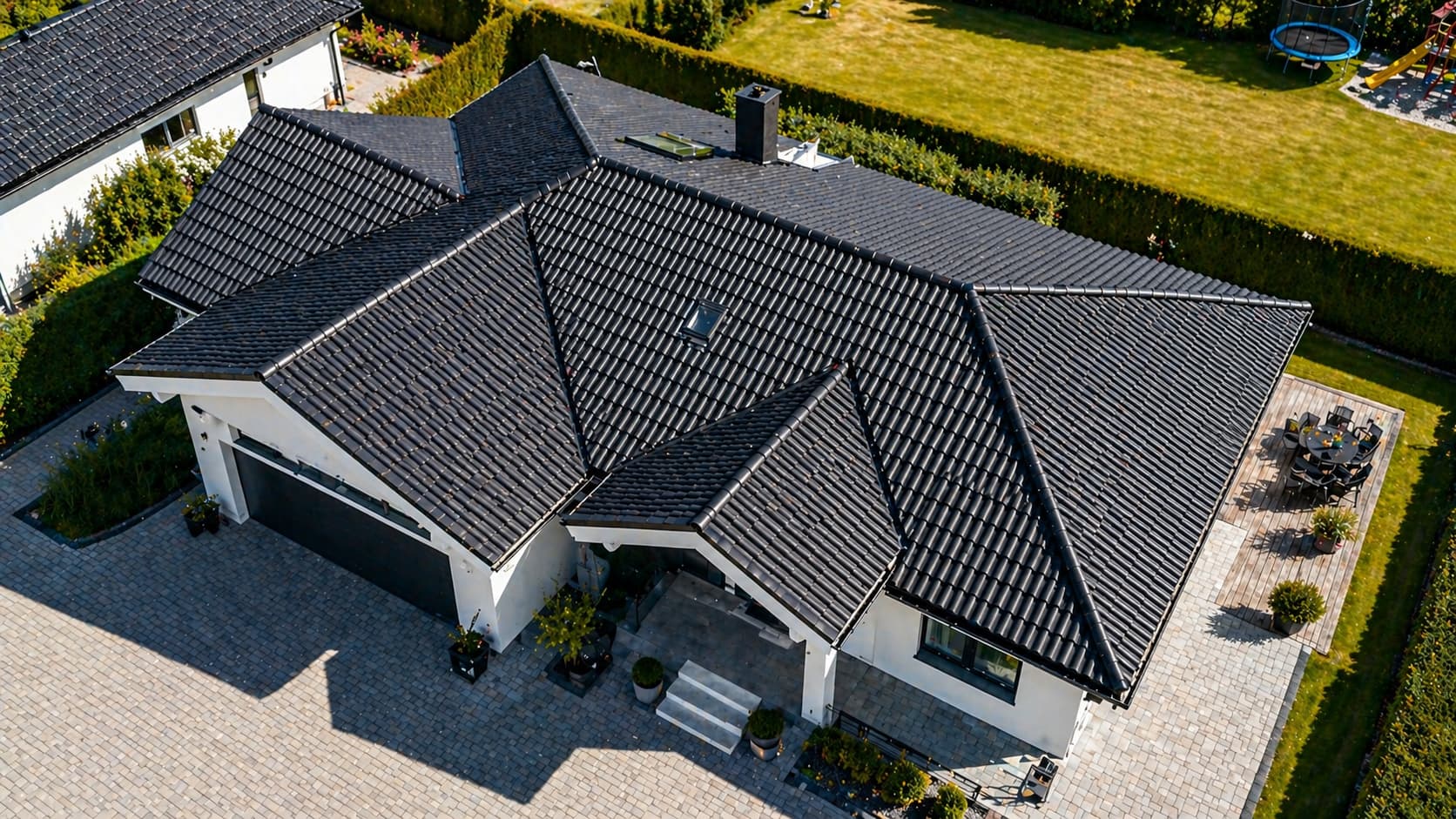
Many houses have roofs with dormers, valleys, L-shapes or extensions, like the roof in the photo above. The approach is always the same: break the roof into simple planes, calculate each one, add them together.
Step-by-step for complex roofs
- Sketch the roof from above (a rough plan view is enough)
- Divide it into rectangles and triangles
- Measure the footprint dimensions of each section
- Apply the slope factor to each section (pitch may vary between sections)
- Add all sections together
- Add overhangs for each eave and verge
Waste Allowance by Material
Once you have the roof surface area, apply a waste factor based on the material and roof complexity:
| Material | Simple roof | Complex roof / many valleys |
|---|---|---|
| Concrete / clay tiles | 5–8% | 10–15% |
| Asphalt shingles | 5–10% | 10–15% |
| Metal roofing (sheets) | 5–8% | 8–12% |
| Slate | 10% | 15–20% |
| Felt / membrane (flat roof) | 10–15% | 15–20% |
Material area = roof surface area × (1 + waste %)
Example: 105 m² roof, concrete tiles, standard complexity: 105 × 1.08 = 113.4 m² of tiles needed.
Roof Area & Solar Panels
If you are considering solar panels, the usable roof area is a key input. A standard residential solar panel covers about 1.7–2.0 m², and you typically need 6–8 m² of usable roof per kWp of installed capacity.
Not all roof area is usable. South-facing planes (in the northern hemisphere) at 30–45° pitch are ideal. North-facing planes, heavily shaded areas, and sections near chimneys or vents are typically excluded.
See how much solar your roof can generate
Use your roof area as input for the solar panel calculator to get system size, annual savings and payback period.
Open Solar Panel Calculator5 Common Calculation Mistakes
1. Using the floor plan area as the roof area
The floor plan gives you the footprint. The actual roof surface is always larger once you account for pitch and overhangs. On a 35° roof, you will be short by around 20% if you use the footprint directly.
2. Ignoring overhangs
Eaves and verges add real surface area that needs to be covered. A 300 mm overhang on all four sides of a 10 × 8 m house adds roughly 7 m², almost a full square of shingles.
3. Using one pitch for a mixed-pitch roof
Extensions and dormers often have a different pitch than the main roof. Measure and calculate each section separately.
4. No extra allowance for valleys and hips
Every hip line and valley requires angled cuts with significant off-cuts. Standard waste percentages assume a simple rectangular roof, so add extra for each hip and valley.
5. Ordering the exact calculated amount
Always round up to the nearest full pack or pallet, and order at least one extra pack as a buffer. Matching materials from a new production batch months later is unreliable.
Quick Reference Summary
| Roof type | Formula |
|---|---|
| Flat roof | (length + overhangs) × (width + overhangs) |
| Gable / pitched roof | footprint area × slope factor |
| Hip roof | Sum of each plane (trapezoids + triangles) |
| Complex roof | Break into sections, calculate each, add together |
| Material quantity | roof area × (1 + waste %) |
Ready to get your exact numbers? Use our roof area calculator: enter your dimensions and pitch for instant results, or try the roof material calculator to get tile, shingle and metal sheet quantities in one step.