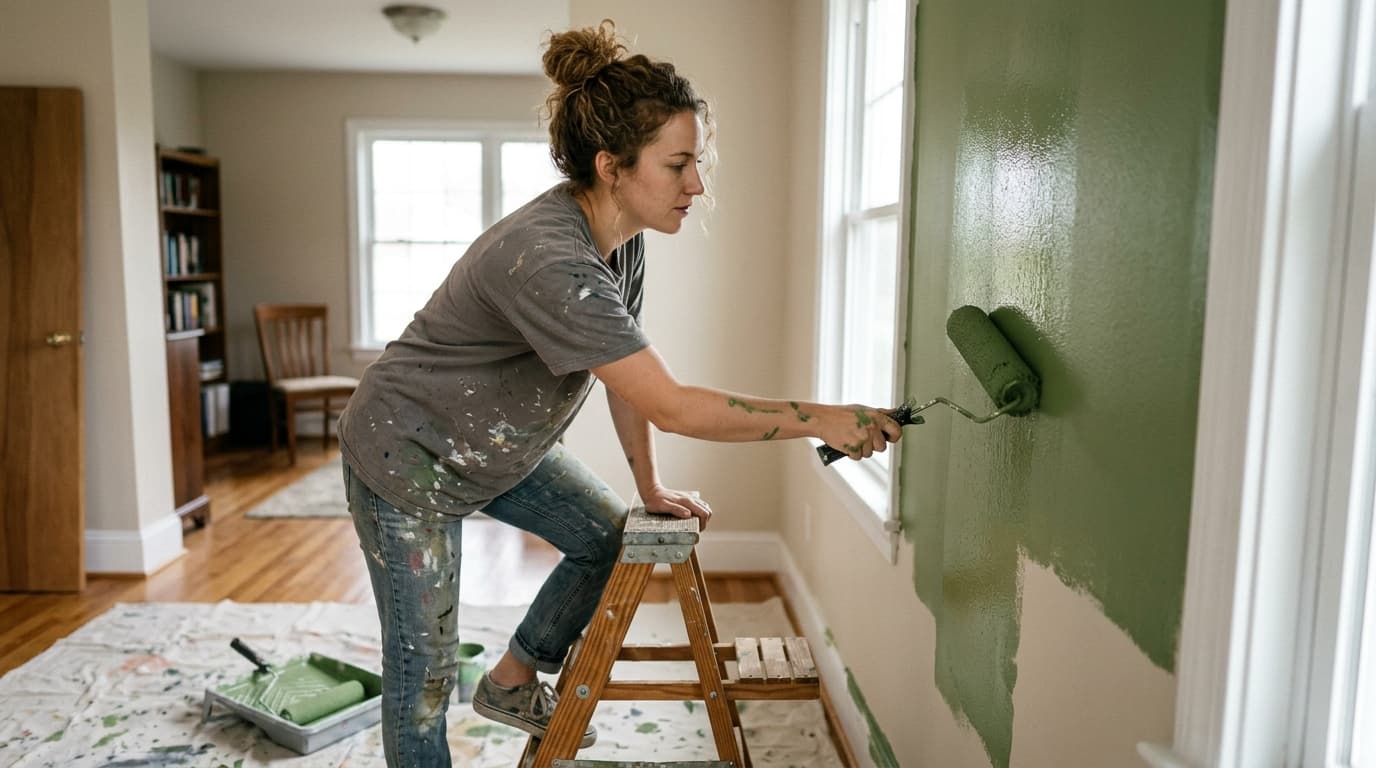
Buying paint should be simple, until you're halfway through the second coat and the last can runs dry. Or you overbuy and end up storing half-used buckets for years.
Paint is predictable when you calculate it properly. In this guide you'll learn the exact formula for walls and ceilings, how coverage rates really work, how many coats to plan for, and how to add a smart safety margin.
The Basics: Coverage, Coats and What Counts as "Area"
Paint calculations are based on three numbers:
- Paintable area: total wall area (and optionally ceiling) minus large openings
- Coverage rate: how much area one litre/gallon covers (printed on the tin)
- Number of coats: usually 2 for walls, sometimes more depending on colour and surface
Typical coverage rates
- Walls (interior): around 8–12 m² per litre (325–450 ft² per gallon)
- Ceilings: similar, but porous ceilings may absorb more
- Primer: varies widely depending on surface
Step 1: Measure Walls (and Ceiling) Correctly
Wall area (metric)
Wall area (m²) = (perimeter in m × wall height in m) − openings
Example: Room 5.0 m × 4.0 m, height 2.4 m
- Perimeter = 2 × (5.0 + 4.0) = 18.0 m
- Wall area = 18.0 × 2.4 = 43.2 m²
Wall area (imperial)
Wall area (ft²) = (perimeter in ft × wall height in ft) − openings
Example: Room 16 ft × 13 ft, height 8 ft
- Perimeter = 2 × (16 + 13) = 58 ft
- Wall area = 58 × 8 = 464 ft²
Ceiling area (optional)
Ceiling area = room length × room width
Step 2: Use the Paint Formula
Paint needed = (area × coats) ÷ coverage
Example (metric)
- Wall area = 43.2 m², Coats = 2, Coverage = 10 m²/litre
- Paint = (43.2 × 2) ÷ 10 = 8.64 litres → round up to 10 L
Example (imperial)
- Wall area = 464 ft², Coats = 2, Coverage = 400 ft²/gallon
- Paint = (464 × 2) ÷ 400 = 2.32 gallons → buy 3 gallons
Skip the manual math: use our calculator
Enter room size, wall height, coverage rate and coats. Get instant results in litres/gallons and a clear shopping list.
Open Paint CalculatorStep 3: Choose the Right Number of Coats
- 2 coats: standard for interior walls on a similar colour
- 3 coats: strong colour change (dark → light), patchy walls, or cheaper paints
- 1 coat: only for touch-ups, or when the system is designed for it on a uniform surface
When primer changes the math
Primer makes topcoat coverage more consistent and can reduce the need for a third coat. However, primer itself is still paint you must budget for.
Common Mistakes That Make You Run Short
1. Using floor area instead of wall area
Paint is about vertical surface area, not floor space. A 20 m² room can easily have 40–50 m² of wall area depending on height.
2. Ignoring texture and porosity
Rough walls, textured ceilings, brick and previously unsealed surfaces all reduce coverage. If unsure, assume lower coverage and add extra.
3. Forgetting the second coat
Many paint calculations look "too high" because people think in one coat. Two coats is the baseline for durable, even results.
4. Not rounding up to real can sizes
Shops sell standard sizes (1 L, 2.5 L, 5 L, 10 L, 1 gal, 5 gal). Always round up to the next practical combination, and keep a little extra for touch-ups.
Conclusion
Calculating paint accurately comes down to a repeatable process:
- Measure wall area using perimeter × height (add ceiling if needed)
- Multiply by the number of coats
- Divide by the coverage rate on your paint
- Round up to real can sizes and add a small safety margin
Ready to get a precise number? Use our paint calculator for instant results and a clear shopping list.