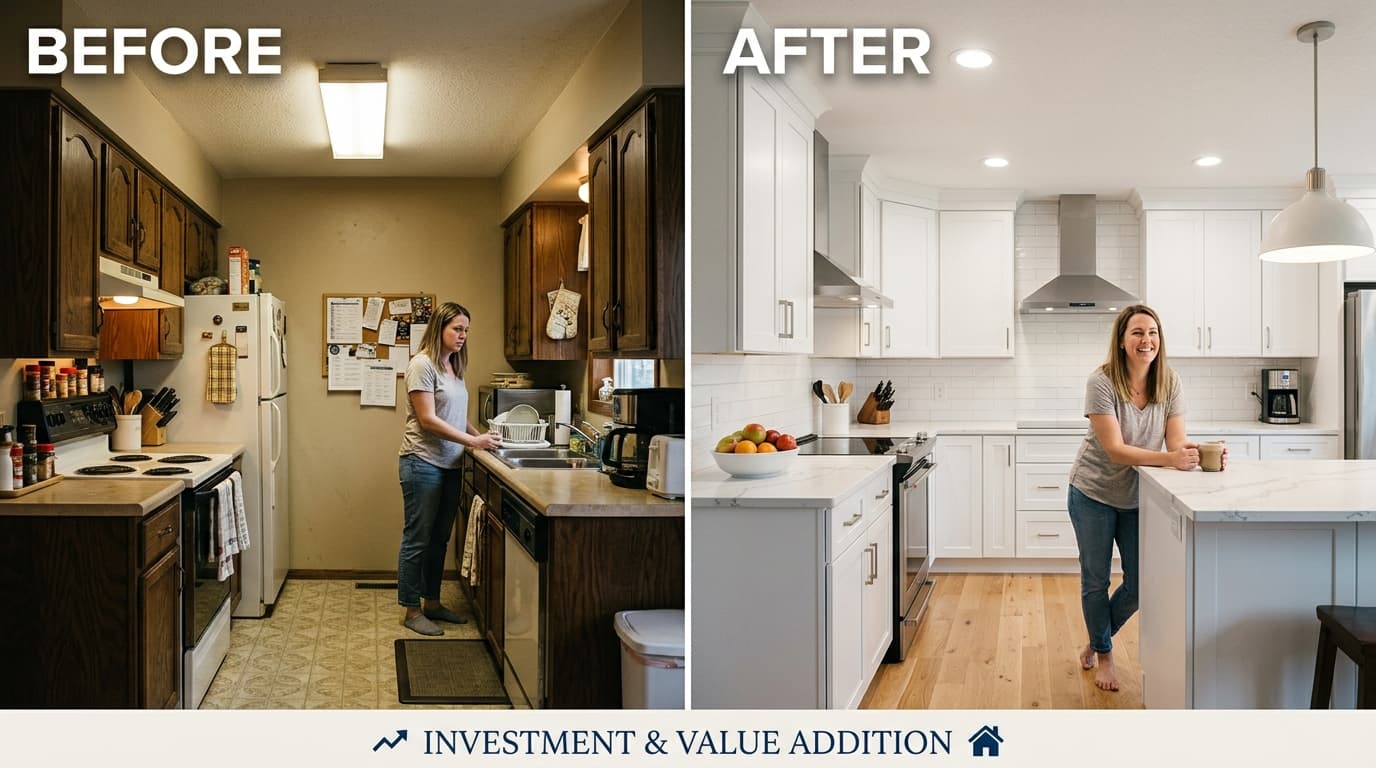
Most homeowners dramatically overestimate what their renovation will add to their property's value. A kitchen that costs €30,000 rarely adds €30,000 in resale value. It might add €20,000, and that still makes it a worthwhile investment if you understand the numbers going in.
This guide covers realistic ROI benchmarks for the most common renovation types, the factors that move the needle, and how to calculate your own numbers before you commit to a project.
How Renovation ROI Works
Renovation ROI measures how much of your spend you recover when you sell the property. The formula is straightforward:
ROI = (Value added by renovation ÷ Renovation cost) × 100
Where value added = estimated sale price after renovation minus the price before renovation.
An ROI of 100% means the renovation adds exactly as much value as it costs. Above 100% means you profit on the renovation itself. Below 100% is the most common scenario: you recover only part of the cost on sale.
ROI Benchmarks by Project Type
These figures represent typical ranges based on general property market data. Your actual return will vary based on location, quality of work and local demand. These benchmarks give a solid starting point for planning.
| Project | Typical ROI | Notes |
|---|---|---|
| Kerb appeal (painting, landscaping, front door) | 80–150% | Low cost, high first-impression impact |
| Kitchen renovation (mid-range) | 60–80% | One of the most scrutinised rooms by buyers |
| Bathroom renovation | 60–75% | Returns vary widely by finish level |
| Loft conversion (bedroom + en-suite) | 60–80% | Adding a bedroom adds measurable value in most markets |
| Extension (rear or side) | 50–70% | High cost; returns depend heavily on location |
| New flooring throughout | 50–70% | Strong visual impact, relatively low labour cost |
| Insulation & energy upgrades | 40–65% | Growing buyer demand; also reduces running costs |
| Luxury kitchen (high-spec fit-out) | 30–50% | Over-improvement risk in average-value streets |
| Swimming pool or home gym | 20–40% | Highly personal; narrows buyer pool |
| Garage conversion | 50–65% | Depends on local demand for parking vs. living space |
Calculate your renovation ROI now
Enter your purchase price, renovation cost and expected sale price. Get ROI, net profit, rental yield and payback period instantly.
Open Renovation ROI CalculatorWhat Affects Your ROI the Most
1. The street ceiling
Every street has an upper price limit. No matter how well you renovate, buyers won't pay above it. If you renovate past that ceiling, the extra spend adds no value. Research the highest sale prices on your street before deciding on a spec level.
2. Quality of work versus cost of work
Buyers notice finish quality. A mid-range kitchen installed cleanly and professionally will return more than a high-spec kitchen with visible imperfections. Labour quality matters as much as materials.
3. Neutral versus personalised design
Renovations in neutral, broadly appealing styles consistently outperform personalised ones. A bold statement kitchen may appeal strongly to some buyers and put others off entirely, which limits your buyer pool and the final price.
4. Whether the renovation is necessary
Replacing a kitchen that already functions is a lower-ROI move than replacing one that is clearly dated and putting buyers off. Fixing genuine problems (damp, outdated electrics, poor layout) returns more than cosmetic upgrades on top of an already decent property.
5. Financing cost
If you borrow to fund the renovation, interest payments reduce your net profit. A €30,000 loan at 5% over 10 years adds roughly €8,000 in interest. That comes directly off your return. Cash financing always produces better ROI.
Sell After Reno vs. Rent It Out
Not every renovated property makes sense to sell immediately. If your local rental yield is strong, holding the property and renting may deliver better long-term returns than a quick sale.
When selling makes more sense
- The local property market is rising fast, so selling now locks in gains before a correction
- Your renovation ROI on sale is above 60% and the net profit is meaningful
- Rental yield in the area is below 4% net and the rental income doesn't justify the ongoing management
- You need the capital for your next project
When renting makes more sense
- Net rental yield exceeds 5–6% of total investment (purchase + renovation costs)
- The local market is flat or falling, so selling now crystallises a loss
- You can hold without needing the capital, and the area has strong long-term appreciation prospects
- The renovation has created a high-quality product that commands a rental premium
The ROI calculator has both scenarios built in. Switch between the "Sell after reno" and "Rent out" tabs to compare your numbers side by side.
3 Mistakes That Kill Renovation ROI
1. Optimistic renovation budgets
The most common reason actual ROI disappoints is that the renovation cost runs over budget. A €25,000 kitchen that ends up costing €38,000 has very different ROI characteristics. Always add a 15–20% contingency to your renovation budget before calculating expected returns.
Not sure what your renovation will cost? Use the Renovation Cost Estimator to build a room-by-room budget before entering figures into the ROI calculator.
2. Ignoring selling costs
Estate agent fees, legal costs and other selling costs typically add up to 1.5–3% of the sale price in the UK. On a €350,000 sale that's roughly €5,000 to €10,500, a significant deduction from your profit that many investors forget to include. (Note: stamp duty is normally paid by the buyer, not the seller.)
3. Comparing to the wrong properties
Estimating post-renovation sale price by looking at renovated properties in a neighbouring, more desirable postcode is a common and costly mistake. Use comparables from your specific street or immediate area, not the wider neighbourhood.
How to Calculate Your Own ROI
Armed with your purchase price, renovation budget and a realistic estimate of the post-renovation sale price, the calculation is straightforward:
| Step | Formula |
|---|---|
| Total investment | Purchase price + purchase costs + renovation cost |
| Value added | Sale price − purchase price |
| Renovation ROI | (Value added ÷ renovation cost) × 100 |
| Net profit | Sale price − total investment − selling costs |
| Gross rental yield | (Annual rent ÷ total investment) × 100 |
| Net rental yield | ((Annual rent − running costs) ÷ total investment) × 100 |
Or skip the spreadsheet. The calculator handles all of this instantly, including loan interest if you're financing part of the renovation.
Try the Renovation ROI Calculator
Enter your numbers and see ROI, net profit, rental yield and payback period. Works in any currency, metric or imperial.
Calculate My ROI