Energy prices have risen sharply over the past few years, and for most households, the question is no longer whether to upgrade their home's energy performance. It's which upgrades to do first and whether the numbers actually work.
This guide ranks six common home energy upgrades by return on investment, using real cost and saving ranges. We also explain why the order matters, how stacked savings are calculated correctly, and where to find grants that can cut your payback period significantly.
Why the order of upgrades matters
Most homeowners think about energy upgrades in isolation. A heat pump salesperson tells you a heat pump will save you 35%. An insulation company says insulation saves 25%. You add them up and expect 60% savings.
The reality is more nuanced, and the order you do things in has a direct effect on how much you spend and how much you save.
The most important rule in home energy retrofitting: insulate before you install mechanical systems.
Here's why. A heat pump is sized to meet your home's peak heat demand (typically on the coldest winter days). A poorly insulated 150 m² home may require a significantly larger heat pump to meet peak demand. The same home, properly insulated, can often be served by a smaller unit. Depending on the starting condition of the building, that difference in capacity can mean a cost saving of €2,000–€5,000 on the equipment alone: enough to pay for a significant part of the insulation upgrade.
Beyond the upfront saving, a smaller heat pump running in a well-insulated home achieves a higher seasonal COP (Coefficient of Performance), meaning it produces more heat per unit of electricity consumed. Over 20 years, that efficiency difference compounds into thousands of euros in lower running costs.
How savings stack: not the way most people think
If insulation saves 25% and a heat pump saves 35%, most people assume the combined saving is 60%. It isn't.
Each upgrade reduces the bill that remains after the previous upgrade. So:
- Start with a €2,400/year energy bill
- Insulation saves 25%: new bill = €1,800 (saving: €600/year)
- Heat pump saves 35% of €1,800 = €630/year saving (actual saving varies: higher when replacing oil or LPG, lower when replacing gas)
- Combined saving: €1,230/year (51.25%, not 60%)
This is how the Home Energy Savings Calculator works: it applies each saving to the remaining bill, not the original total. The difference matters because overestimating savings leads to underestimating payback periods.
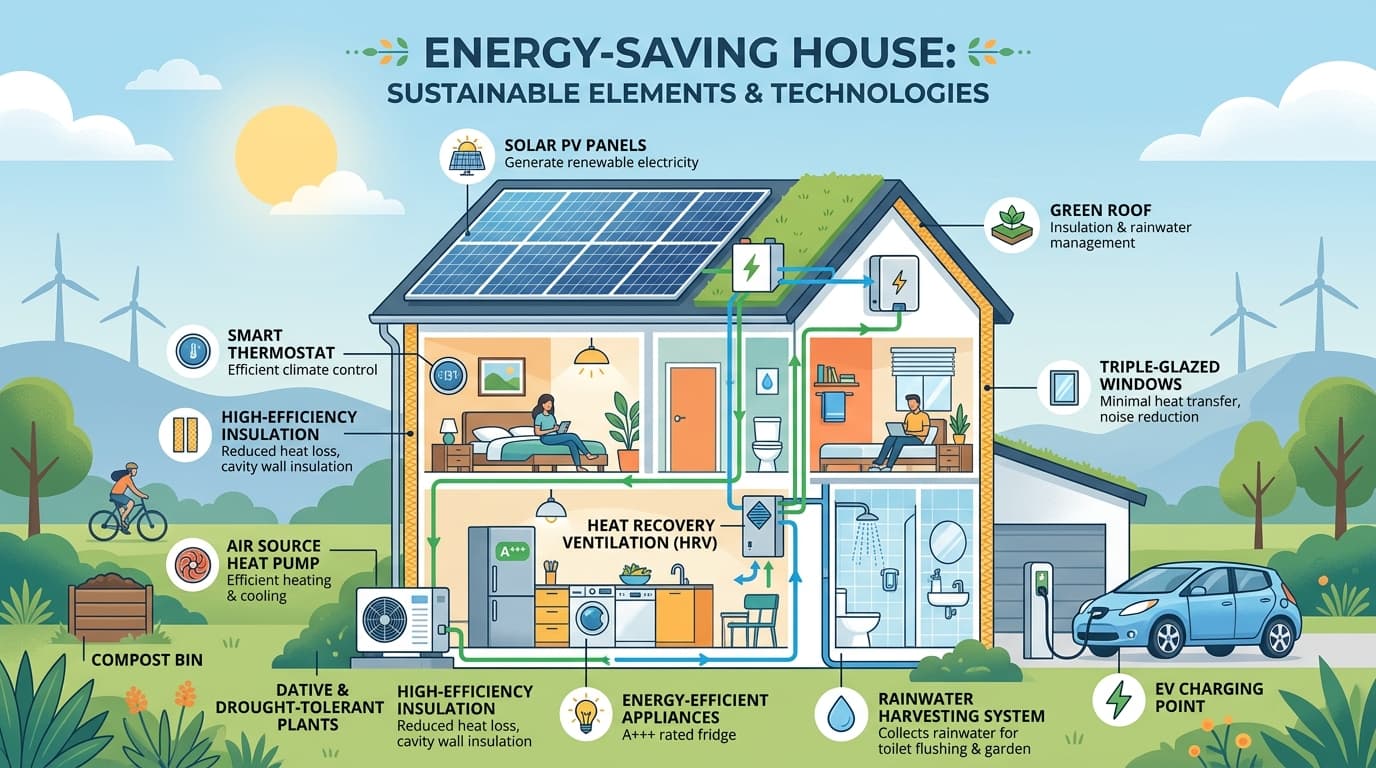
All 6 upgrades ranked by ROI
The table below summarises typical costs, savings and payback periods. These are ranges: your actual numbers depend on your home size, starting energy bill and local energy prices. Use the calculator at the bottom of this article to run your own numbers.
| # | Upgrade | Typical cost | Bill saving | Payback |
|---|---|---|---|---|
| 1 | Smart thermostat | €150–€350 | 10–15% on heating | 1–2 years |
| 2 | LED lighting | €200–€600 | 5–12% on electricity | 1–3 years |
| 3 | Insulation | €2,000–€8,000 | 20–35% on heating | 5–8 years |
| 4 | Heat pump | €8,000–€18,000 | 25–45% on heating | 7–14 years |
| 5 | Solar panels | €5,000–€12,000 | 15–30% on electricity | 7–12 years |
| 6 | Windows & draught sealing | €3,000–€15,000 | 10–20% on heating | 8–20 years |
1. Smart thermostat: fastest payback
A smart or programmable thermostat stops heating an empty house. Learning thermostats (like Nest or Tado) also optimise heating schedules based on weather forecasts and occupancy patterns. The saving is modest in percentage terms, but the cost is low enough that payback is almost immediate. This is the one upgrade that makes sense regardless of what else you plan to do, and it works with any heating system, including whatever you're replacing.
2. LED lighting: cheapest to do
LED bulbs use 75–80% less electricity than halogen equivalents and last 10–25 times longer. The saving on your total energy bill is modest (lighting typically represents 10–15% of household electricity use), but the upfront cost is low enough that it's worth doing as a first step. If you later add solar panels, reducing lighting consumption means your panels cover a larger share of your remaining electricity use.
3. Insulation: the foundation of everything else
Roof insulation consistently delivers the best saving-per-pound of any major upgrade. Heat rises, and in an uninsulated loft, a significant portion of your heating escapes through the roof. Adding 200–300 mm of mineral wool or blown insulation to a cold loft typically costs €500–€1,500 and pays back in under 3 years. Cavity wall insulation adds another 15–20% saving for most semi-detached and detached homes built before 1995. External wall insulation is more expensive but applicable to solid-wall homes where cavity fill isn't possible.
4. Heat pump: largest absolute saving over time
A heat pump doesn't generate heat: it moves it from the outside air (or ground) into your home, delivering 3–5 units of heat per unit of electricity consumed. This makes it far more efficient than any combustion system. The saving is highest when replacing oil, LPG or electric storage heaters, and lower when replacing natural gas (because gas is currently cheap per kWh in many markets). Payback improves significantly when grants are applied. Use the Heat Pump ROI Calculator to model your specific situation.
5. Solar panels: best when combined with a heat pump
Solar panels work particularly well in combination with a heat pump. The heat pump increases your electricity demand significantly, and solar generation offsets a portion of that demand during daylight hours. This synergy means a 4–6 kWp solar system installed alongside a heat pump often pays back faster than either system alone. The saving also increases over time as electricity prices rise, making solar a hedge against future tariff increases. See the Solar Panel Calculator for detailed output modelling.
6. Windows and draught sealing: longest payback, but worth doing
Windows rank last on ROI, but that doesn't mean they're not worth doing. Draughty single-glazed windows account for 10–25% of heat loss in older homes. Draught-proofing (sealing gaps around frames, letter boxes and keyholes) costs very little and pays back in under a year. Full replacement with double or triple glazing is far more expensive and takes longer to recoup, but it also improves comfort significantly, reduces noise, and contributes to an improved EPC rating. Consider window replacement alongside a heat pump installation, since the total heat loss reduction means you can size the heat pump smaller.
Grants and subsidies worth knowing about
Government incentives can dramatically shorten payback periods, in some cases halving the effective cost of an upgrade. Here are the main schemes currently available in key markets:
- United Kingdom (England & Wales): The Boiler Upgrade Scheme (BUS) offers £7,500 for air-to-water and ground source heat pumps. The Great British Insulation Scheme provides free or subsidised insulation for low-income households. (Scotland and Northern Ireland have separate schemes, check your devolved government's website.)
- Ireland: SEAI grants cover heat pumps, external wall insulation and attic insulation. Grant levels are updated regularly, so check seai.ie for current amounts before budgeting. The One Stop Shop scheme manages the full retrofit process.
- Germany: The BEG (Bundesförderung für effiziente Gebäude) scheme covers 15–35% of costs for heat pumps, insulation and windows, depending on the starting energy class of the building.
- France: MaPrimeRénov covers up to 90% of renovation costs for low-income households, including heat pumps and insulation. CEE certificates provide additional funding from energy suppliers.
- United States: The Inflation Reduction Act provides tax credits of up to $2,000 for heat pumps and $1,200 for insulation and windows per year, plus state-level rebates through the HOMES program.
- Australia: State-based schemes vary significantly. Victoria's Energy Upgrades program offers point-of-sale discounts on heat pumps, solar and insulation through accredited installers.
Effect on home value
Energy upgrades don't just reduce your bills. They also affect what your home is worth.
Research across European and US housing markets consistently shows that homes with high energy performance ratings sell for more. Research across European housing markets consistently shows that homes with better energy ratings sell for more, with studies typically finding a premium of 1–3% per EPC band improvement. The effect varies by market, property type and buyer profile, but the direction is consistent: higher energy ratings correlate with higher sale prices.
In practical terms, a full retrofit (insulation, heat pump and solar panels) can move a home two or three EPC bands. That improvement, combined with the annual savings, means the financial case for upgrading is stronger than the payback period alone suggests.
For investors and landlords, the calculation is even more direct: minimum EPC standards for rental properties are tightening in many markets, making energy upgrades a requirement rather than a choice within the coming years.
Calculate your own combined savings
Every home is different. The ranges in this guide are useful for planning, but your actual savings depend on your current energy bill, home size, local climate and the specific products installed. Use the calculator below to model your exact situation: select the upgrades you're considering, enter your installed cost estimates and see your combined saving, payback period and year-by-year net value.