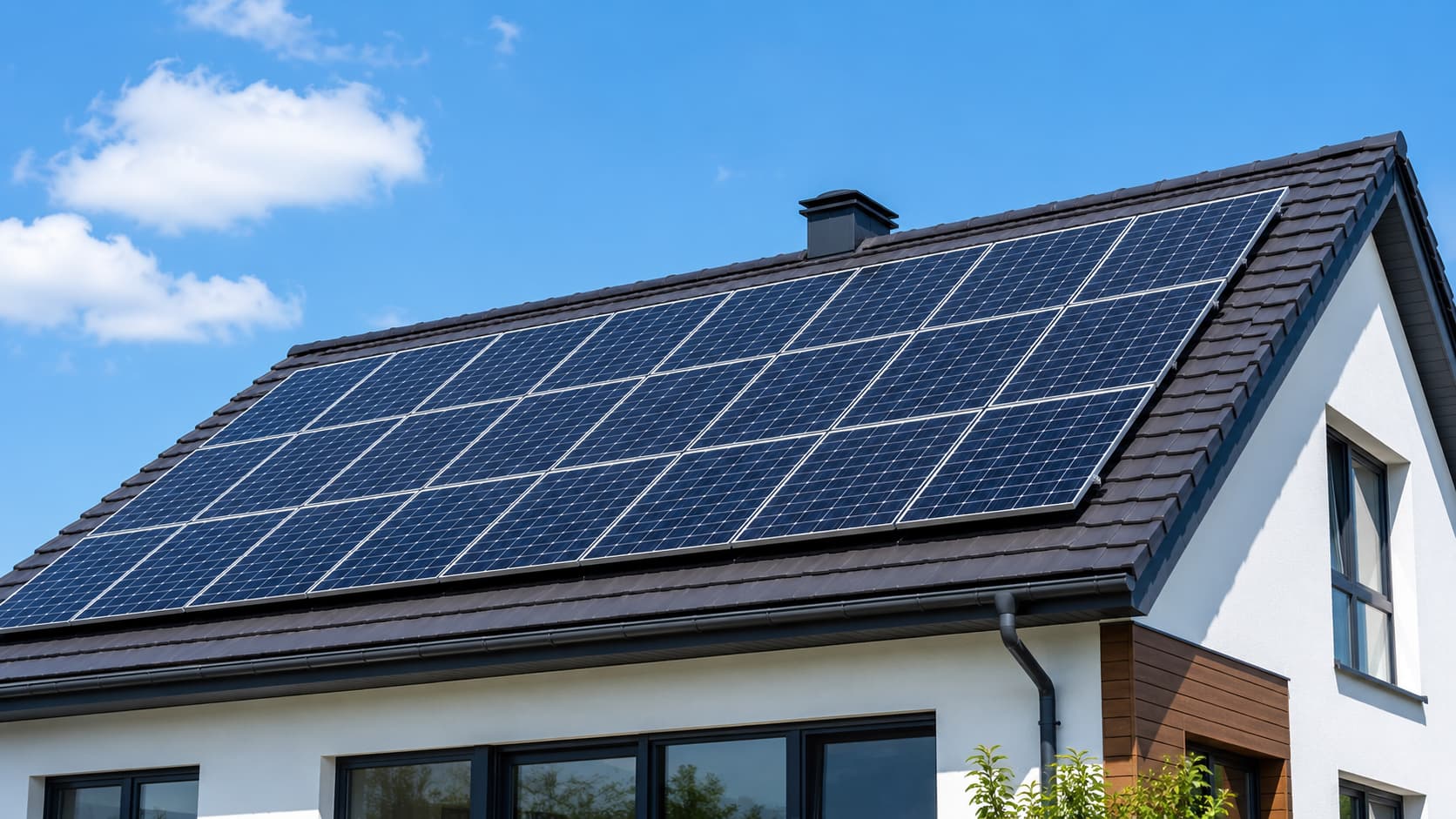
The number of solar panels you need depends on three things: how much electricity you use each year, how much sunlight your location receives, and the wattage of the panels you choose. Get those three numbers right and the calculation is straightforward. Miss one of them and you end up with a system that is either too small to cover your needs or oversized and overpriced.
This guide walks through the complete sizing process with real numbers, explains the variables that change the answer depending on where you live, and helps you understand what to expect in terms of savings and payback.
The formula for sizing a solar system
The core calculation has two steps: working out the system size you need in kilowatts, then converting that into a number of panels.
Round up to the nearest whole panel.
As a practical example: a UK household using 4,000 kWh per year, with 950 peak sun hours, needs a 4.2 kW system. With 400 W panels, that is 4,200 ÷ 400 = 10.5, rounded up to 11 panels.
The same household in southern Spain, with 1,300 peak sun hours, needs only 3.1 kW: around 8 panels. Location alone changes the answer by three panels and roughly €2,000 in equipment cost.
What are peak sun hours?
Peak sun hours are not the same as daylight hours. They represent the equivalent number of hours per year when solar irradiance averages exactly 1,000 W per square metre. That is the standard test condition used to rate panels, so a 400 W panel produces 400 Wh in one peak sun hour.
A location that gets 12 hours of daylight in summer but half-strength sun for most of that time might only deliver 5 to 6 peak sun hours per day. In winter, that same location may drop to 1 to 2 peak sun hours per day.
Annual peak sun hours smooth out this seasonal variation into a single number you can use for system sizing. Here are typical values by region:
| Region | Annual peak sun hours | Daily average |
|---|---|---|
| Northern Europe (Scotland, Norway, Sweden) | 800 h/year | 2.2 h/day |
| UK, Ireland, Denmark | 950 h/year | 2.6 h/day |
| Southern UK, Netherlands, Germany | 1,100 h/year | 3.0 h/day |
| Spain, Italy, Portugal, California | 1,300 h/year | 3.6 h/day |
| Middle East, Arizona, Texas | 1,600 h/year | 4.4 h/day |
| Tropical regions, Australia (north) | 1,900 h/year | 5.2 h/day |
How many panels by location
The table below shows the number of 400 W panels required to cover 100% of annual electricity usage for three common household sizes, across the six regions above. These figures assume no shading and an optimal south-facing roof pitch of 30 to 40 degrees.
| Region | 3,000 kWh/yr | 4,500 kWh/yr | 7,000 kWh/yr |
|---|---|---|---|
| Northern Europe (800 h) | 10 panels | 15 panels | 22 panels |
| UK / Ireland (950 h) | 8 panels | 12 panels | 19 panels |
| S. UK / Germany (1,100 h) | 7 panels | 11 panels | 16 panels |
| Spain / Italy (1,300 h) | 6 panels | 9 panels | 14 panels |
| Middle East / Arizona (1,600 h) | 5 panels | 8 panels | 11 panels |
| Tropical / Australia (1,900 h) | 4 panels | 6 panels | 10 panels |
Note that covering 100% of your usage with solar does not mean you will use 100% solar electricity. Unless you have battery storage, panels generate during the day and you export excess power to the grid. In the evening and on cloudy days, you draw from the grid. A system sized for 100% of your annual usage typically covers 50 to 70% of actual consumption directly, with the rest exported or offset through export tariffs.
How much roof space do you need?
A modern 400 W panel is approximately 1.72 m tall by 1.13 m wide, giving a footprint of around 1.94 m². In practice, you need to allow for mounting rails and spacing between panels, so the usable area per panel is closer to 2.1 to 2.2 m².
A 10-panel system therefore needs roughly 21 to 22 m² of clear, unobstructed roof surface. A 16-panel system needs around 34 to 36 m².
Roof orientation also matters. A south-facing roof at 30 to 40 degrees pitch captures the most energy in the northern hemisphere. East and west-facing roofs produce around 15 to 20% less than a south-facing equivalent. North-facing roofs in the northern hemisphere are generally not viable without a very shallow pitch and are not recommended.
If your roof area is limited but you want to maximise output, higher-wattage panels (450 W to 500 W) produce more per square metre, though they cost more per panel. The net cost per watt is often similar, so the main reason to choose higher-wattage panels is to fit more capacity on a constrained roof.
Choosing the right panel wattage
Solar panels are sold in a range from around 300 W (older or budget panels) up to 500 W or more for premium high-efficiency models. The wattage rating affects how many panels you need but not necessarily the total system cost, since higher-wattage panels cost more per panel but you need fewer of them.
| Panel wattage | Panels for 4 kW system | Roof area needed | Typical use case |
|---|---|---|---|
| 300 W | 14 panels | ~29 m² | Budget installs, older stock |
| 350 W | 12 panels | ~25 m² | Standard efficiency |
| 400 W | 10 panels | ~21 m² | Most common modern panel |
| 450 W | 9 panels | ~19 m² | High efficiency, space-limited roofs |
| 500 W | 8 panels | ~17 m² | Premium, commercial grade |
For most homeowners, 400 W panels represent the best balance of cost, availability and efficiency. They are the standard offering from most installers and the wattage the industry has largely converged on for residential systems.
Payback period and annual savings
The payback period depends on three variables: what you paid for the system, how much electricity you generate and use on-site, and what you are paid for electricity you export to the grid.
A typical 4 kW system in the UK costs £6,000 to £9,000 installed and generates around 3,400 to 3,800 kWh per year. At an electricity price of £0.28 per kWh and assuming 50% self-consumption, annual savings are approximately £475 to £530 per year from avoided grid electricity. Export tariffs (Smart Export Guarantee in the UK) add £80 to £150 per year on top. Total annual benefit: £550 to £680, giving a payback of 9 to 14 years.
In southern Europe with higher irradiance and similar electricity prices, the same system generates 30 to 40% more electricity and the payback shortens to 7 to 10 years.
After payback, you have 10 to 15 years of remaining panel life generating electricity at essentially zero cost. A well-installed system with quality panels and inverter will still produce 80 to 85% of its original output after 25 years, according to manufacturer degradation guarantees.
The 25-year net saving for a 4 kW UK system (after subtracting the initial cost) is typically £5,000 to £10,000. In sunnier climates with higher self-consumption, that figure rises to £12,000 to £18,000.
Use the calculator for your exact numbers
The tables and examples above give you a reliable ballpark. For numbers specific to your electricity usage, location and electricity price, use one of the calculators below. The full calculator includes battery storage, export tariffs, roof orientation and a detailed 25-year ROI projection. The quick estimate takes under a minute if you just want a system size and payback period.