Ordering roof materials is not guesswork, but a surprising number of re-roofing jobs run short because the estimate was based on the floor area instead of the actual roof surface, or because waste was not factored in. This guide gives you the exact method used by roofing contractors, broken down by material type.
The Core Formula
Every roof material calculation follows the same two-step logic:
- Get the actual roof surface area (not the footprint, but the sloped surface)
- Apply a waste factor based on the material and roof complexity
Material area needed = roof surface area × (1 + waste %)
From there, divide by the coverage per tile, bundle or sheet to get the quantity to order.
Step 1: Get Your Roof Area
The most common mistake is using the house footprint as the roof area. The actual roof surface is always larger than the footprint because of the pitch (slope) and overhangs.
For a simple gable (pitched) roof:
Roof surface area = footprint area × slope factor
| Pitch angle | Slope factor | Extra area vs footprint |
|---|---|---|
| 15° | 1.035 | +3.5% |
| 25° | 1.083 | +8.3% |
| 30° | 1.155 | +15.5% |
| 35° | 1.221 | +22.1% |
| 40° | 1.305 | +30.5% |
| 45° | 1.414 | +41.4% |
Need to calculate the roof surface area first? See our roof area guide for step-by-step instructions on pitched, hip and complex roofs, or go straight to the roof area calculator.
Step 2: Add Waste Allowance
Waste comes from cuts around chimneys, valleys, hips, dormers and roof edges. Even a simple rectangular roof needs some allowance for end cuts at the ridge and eaves.
| Roof complexity | Typical waste | When to use |
|---|---|---|
| Simple gable, no features | 5–8% | Straightforward rectangular roof, no valleys |
| Standard (some cuts) | 10% | Most houses: a chimney, one or two hips |
| Complex (many features) | 12–15% | Multiple valleys, dormers, L-shaped plan |
| Intricate pattern or slate | 15–20% | Decorative patterns, natural slate, many angles |
Calculate your roof material instantly
Enter your roof area and material type. Get quantity, waste and pack count in one step.
Open Roof Material CalculatorConcrete & Clay Tiles
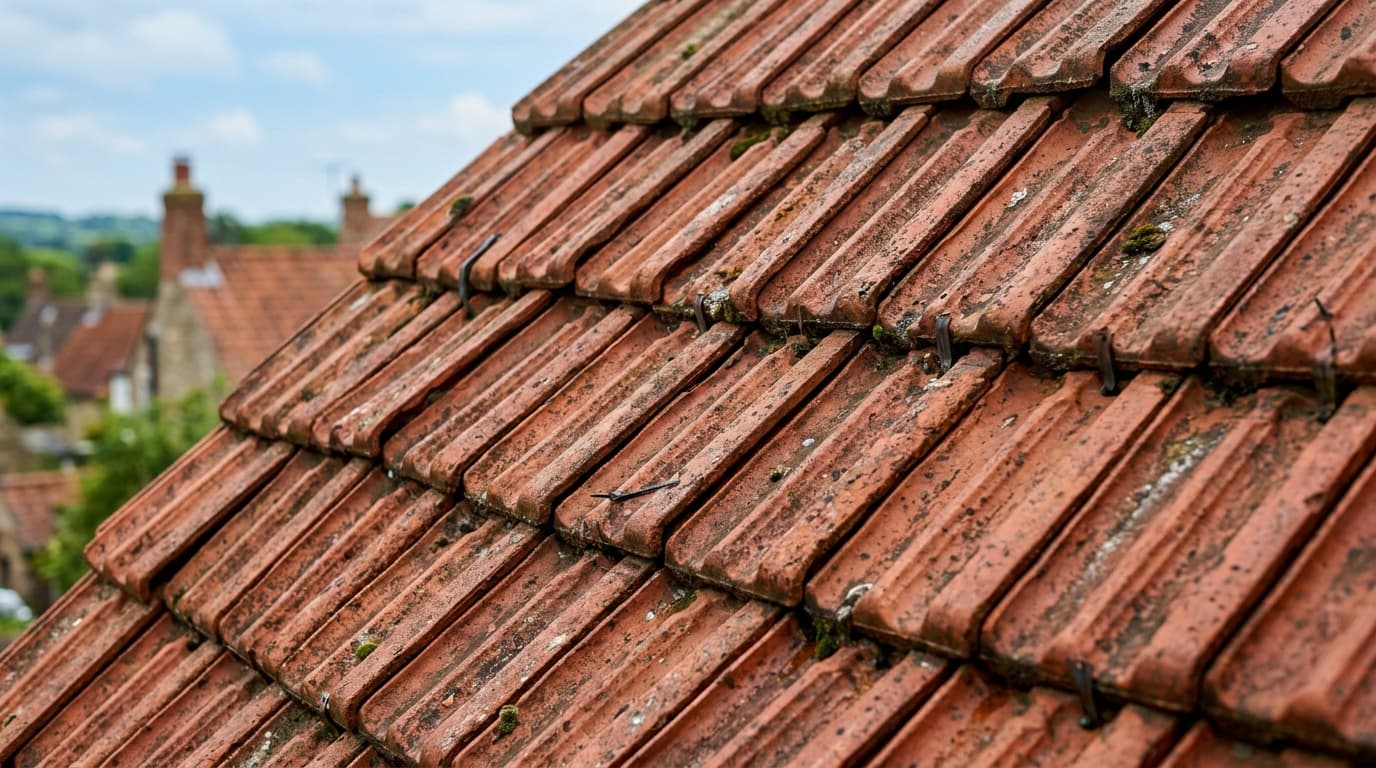
Tiles are sold individually or by the pallet. The key number you need from the manufacturer is the tile coverage: how many tiles cover one square metre, including the overlap.
Tiles needed = material area ÷ coverage per tile
Example: Roof surface 110 m², 10% waste, tiles covering 0.06 m² each:
- Material area: 110 × 1.10 = 121 m²
- Tiles: 121 ÷ 0.06 = 2,017 tiles → round up to nearest pallet
Typical coverage figures
| Tile type | Tiles per m² | Notes |
|---|---|---|
| Concrete interlocking | 9–12 | Most common UK / EU residential tile |
| Clay plain tile | 60–65 | Smaller tile, higher count per m² |
| Clay Roman / pantile | 14–18 | Varies by manufacturer |
| Large-format concrete | 7–9 | Faster to lay, fewer cuts needed |
Asphalt Shingles
Shingles are sold in bundles, where each bundle typically covers a fixed area. Three bundles usually make one square: 9.3 m² (100 ft²) of roof surface.
Bundles needed = ⌈material area ÷ coverage per bundle⌉
Example: Roof surface 130 m², 10% waste, 3 m² per bundle:
- Material area: 130 × 1.10 = 143 m²
- Bundles: ⌈143 ÷ 3⌉ = 48 bundles
Ridge and hip shingles
Hip and ridge caps are sold separately and are calculated by linear metre of hip/ridge length, not by area. Measure the total length of all ridges and hips, then check the manufacturer's linear coverage per bundle.
Metal Roofing Sheets
Metal roofing (standing seam, corrugated or profiled panels) is ordered by the sheet. Each sheet has a fixed width and a usable coverage width (narrower than the overall width due to overlap).
Sheets per run = ⌈roof width ÷ usable sheet width⌉
Sheet length = rafter length + overhang allowance
Example: Roof plane 12 m wide × 6 m rafter length, sheet usable width 0.9 m, 150 mm overhang at eave:
- Sheets across: ⌈12 ÷ 0.9⌉ = 14 sheets
- Sheet length: 6.0 + 0.15 = 6.15 m → order 6.2 m sheets
- Total: 14 sheets at 6.2 m
Slate
Natural and fibre-cement slate is priced per slate or per m². Coverage depends on the slate size and the headlap: the amount one slate overlaps the one two courses below.
Standard headlap is 75 mm for pitches above 25°. Increase to 100 mm for pitches below 25°.
| Slate size (mm) | Slates per m² (75 mm lap) |
|---|---|
| 500 × 250 | 15.6 |
| 400 × 200 | 25.0 |
| 300 × 150 | 45.0 |
| 600 × 300 | 9.8 |
Slate waste is higher than tiles. Allow 15–20% for natural slate (some slates are unusable due to natural defects) and 10% for fibre-cement slate.
What to Order (and What Not to Skip)
The quantity calculation gets you to the minimum. A proper order also includes:
- Ridge tiles / ridge caps: calculated by ridge length, not area
- Hip tiles: calculated by total hip length
- Valley trough or soaker tiles: one per course per valley
- Verge tiles or dry-fix verge system: by linear metre of verge
- Underlayer / roofing felt: typically 15% overlap, so order 115% of roof area
- Battens: total length = number of courses × roof width (battens run horizontally across the roof); add 10% for overlaps and waste
- Fixings: nails or clips; number depends on tile type and wind zone
Quick Reference Table
| Material | Unit sold | Waste (simple) | Waste (complex) |
|---|---|---|---|
| Concrete / clay tiles | Per tile or pallet | 5–8% | 10–15% |
| Asphalt shingles | Bundle (~3 m²) | 5–10% | 10–15% |
| Metal sheets | Per sheet (cut to length) | 3–5% | 5–8% |
| Natural slate | Per slate or m² | 15% | 20% |
| Fibre-cement slate | Per slate or m² | 10% | 12–15% |
Ready to get your exact numbers? Use our roof material calculator: enter your roof area, material type and roof complexity for instant quantities. Or start from scratch with the roof area calculator to get the surface area first.