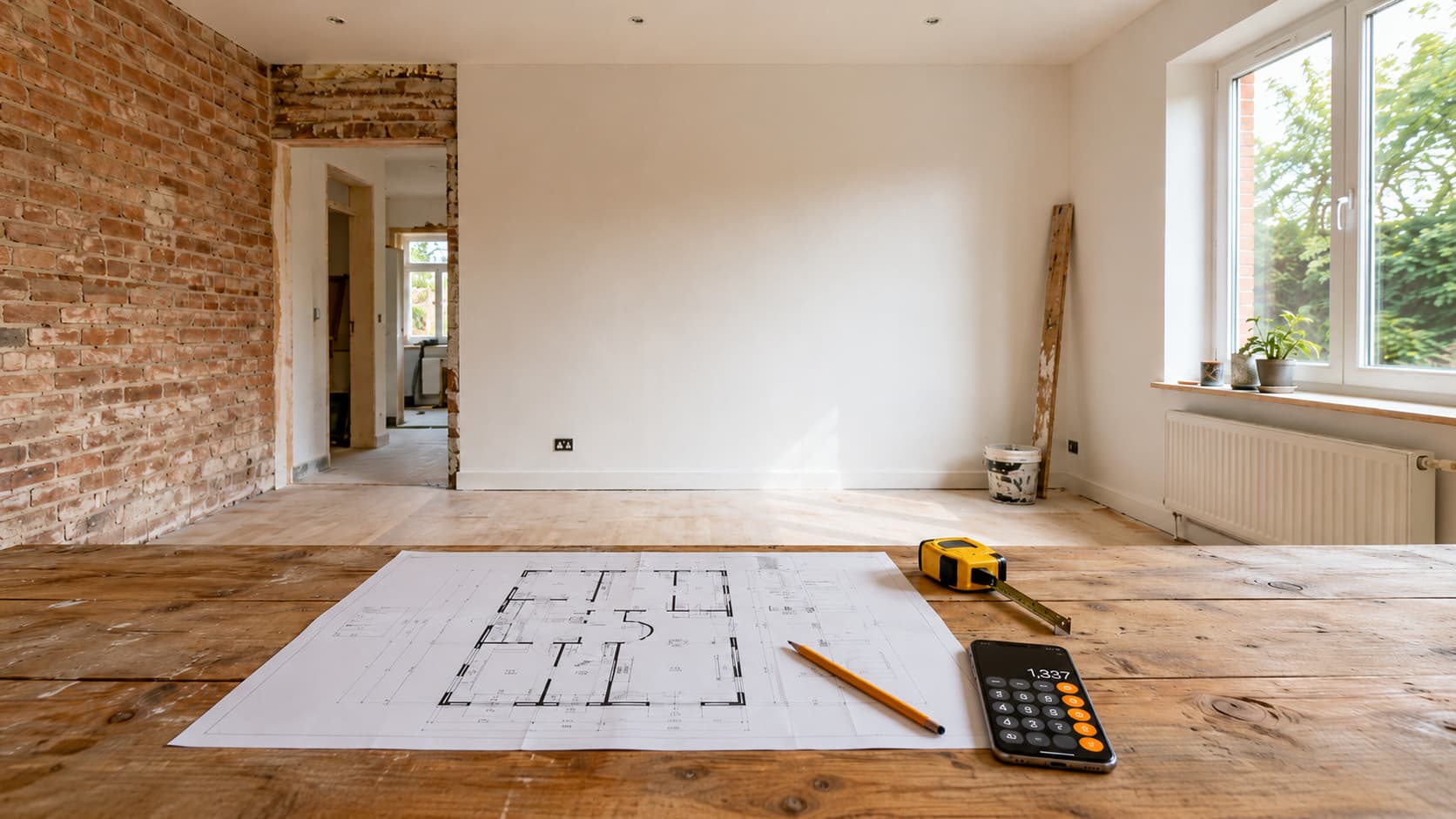
Most people start planning a renovation before they have any idea what it will cost. They picture the finished result, get excited, and start calling contractors without a budget in hand. That is where the trouble begins.
A realistic renovation estimate is not about guessing well. It is about breaking the project into parts you know how to price. This article gives you that method.
Why renovation estimates go wrong
Renovation budgets fail for the same reasons across nearly every project. Understanding them before you start puts you in a much stronger position.
People estimate at the room level without going deeper. A kitchen renovation covers plumbing, electrical, carpentry, flooring, and fitting. Lumping all of that into one number means you are pricing the idea of a renovation, not the actual work.
Labour gets underestimated. Materials have list prices. Labour is quoted by tradespeople, and those quotes vary by market, trade demand, and access conditions. In many markets, labour often accounts for 40 to 60 percent of total renovation cost. It is often one of the largest and most variable parts of the budget.
Scope grows. You plan to refresh a bathroom, then the tiler finds damaged substrate under the existing tiles. You plan to rewire one room, then the electrician flags a problem that extends the work into the hallway. Unplanned findings are common, especially in older properties.
Contingency is treated as optional. It is not. A budget without a contingency is a budget that breaks at the first surprise.
Breaking costs down room by room
The most reliable way to estimate renovation costs is to work room by room, then trade by trade within each room.
Start with a scope list for each room you plan to renovate. Write down every trade involved: demolition, structural, electrical, plumbing, plastering, carpentry, tiling, flooring, painting, and fitting. Then note the materials and work required for each trade in that room.
This forces specificity. "New bathroom" is not a scope. "New bathroom: remove existing suite, retile walls and floor (12 m²), fit new bath, shower, basin and WC, replace ventilation, repaint ceiling" is a scope. A tradesperson gives you a price for the second, not the first.
Once you have a scope, you have something a contractor prices. The quote you receive will be more accurate, and you will know exactly what it covers.
What drives the price up
The same renovation in two different properties costs different amounts. Here is what moves the price.
Age of the property. Older buildings hide problems. Lead pipes, outdated wiring, uneven structures, moisture behind walls. Tradespeople working in older properties price for the unknown because they regularly find things that were not expected. The older the building, the more contingency you need to hold.
Access. A bathroom on the ground floor is easier to work in than one accessed by a narrow staircase or on an upper floor of a building without a lift. Tight access raises labour time and cost.
Specification level. A mid-range kitchen and a premium kitchen differ by a factor of three or four in materials cost for the same footprint. The trade labour to fit them is similar. Your specification choices are the biggest variable you control.
Trade availability. In markets with high demand for skilled tradespeople, quotes are higher and waiting times are longer. Getting quotes early and allowing realistic timelines for the work is a practical planning decision.
How much you take on yourself. Painting, basic demolition, and some finishing work are tasks many homeowners handle. Each trade you remove from a contractor quote reduces the total. Check first whether doing so affects the contractor's warranty or insurance obligations before you commit.
Labour vs. materials: where your money goes
Labour often accounts for between 40 and 60 percent of many home renovation budgets. The exact split depends on the type of work. Trade-heavy renovations such as electrical rewiring, plumbing reroutes, and plastering sit at the higher end. Material-heavy work such as flooring or kitchen fitting with ready-made units sits lower.
| Trade | Typical labour share | Example range per room |
|---|---|---|
| Electrical rewiring | 60–70% | USD 800–3,000 / GBP 600–2,000 / EUR 700–2,500 |
| Plumbing | 55–65% | USD 1,000–5,000 / GBP 800–4,000 / EUR 900–4,500 |
| Plastering | 60–70% | USD 500–2,000 / GBP 400–1,500 / EUR 450–1,800 |
| Tiling (walls and floor) | 40–55% | USD 600–3,000 / GBP 500–2,500 / EUR 550–2,800 |
| Flooring (supplied and laid) | 30–45% | USD 500–3,000 / GBP 400–2,500 / EUR 450–2,800 |
| Kitchen fitting | 30–40% | USD 2,000–8,000+ / GBP 1,500–6,000+ / EUR 1,800–7,000+ |
| Painting and decorating | 50–65% | USD 400–2,500 / GBP 300–2,000 / EUR 350–2,200 |
These are broad planning ranges, not fixed market prices or currency conversions. Local rates vary significantly. Always get quotes from local contractors before finalising your budget.
Get quotes from at least two contractors per trade before settling on a number. Online cost guides give reference ranges, but local market rates vary enough that your actual quotes may land well outside those ranges in either direction.
Contingency: the reserve most projects skip
A renovation contingency is an amount held in reserve for costs that were not in the original scope. It is not money you plan to spend. It is the budget that protects you from the findings that show up in nearly every renovation project.
A common rule of thumb is 10 to 20 percent of the total project cost.
For a newer property with a straightforward scope, 10 percent is adequate. For an older property, or a project involving structural changes, plumbing reroutes, or anything behind walls and floors, 20 percent is the more appropriate figure.
A 10 percent contingency on a USD 30,000 renovation is USD 3,000 held in reserve. If you do not need it, you finish under budget. If something goes wrong behind the walls, you have options rather than a problem.
How to build your estimate
Getting renovation costs on paper before work starts is a five-step process.
- List every room in scope. Be specific about what changes in each room and what stays the same.
- Write a trade-by-trade scope for each room. Every trade that sets foot in the room should appear on the list with the work they will do.
- Get at least two quotes per trade. One quote is a number. Two quotes are a comparison. Three give you a market rate.
- Add materials costs separately. Agree with your contractor whether you supply materials or they do, and price accordingly. This avoids ambiguity in quotes and gives you control over specification choices.
- Add contingency on top of the total. 10 percent for a straightforward project in a newer property. 20 percent for anything more complex or in an older building.
That process gives you a number built from real data, not one borrowed from an average. It takes longer than searching for cost guides online, but it reflects your project, your property, and your local market.
Estimate your renovation costs room by room
Enter your rooms, trades, and specification level to get a cost breakdown and total budget before you contact contractors.
Open Renovation Cost EstimatorBefore you sign any agreement with a contractor, run the numbers in the estimator and get at least two quotes per trade. A structured scope combined with real market quotes turns a renovation plan into a budget that holds.