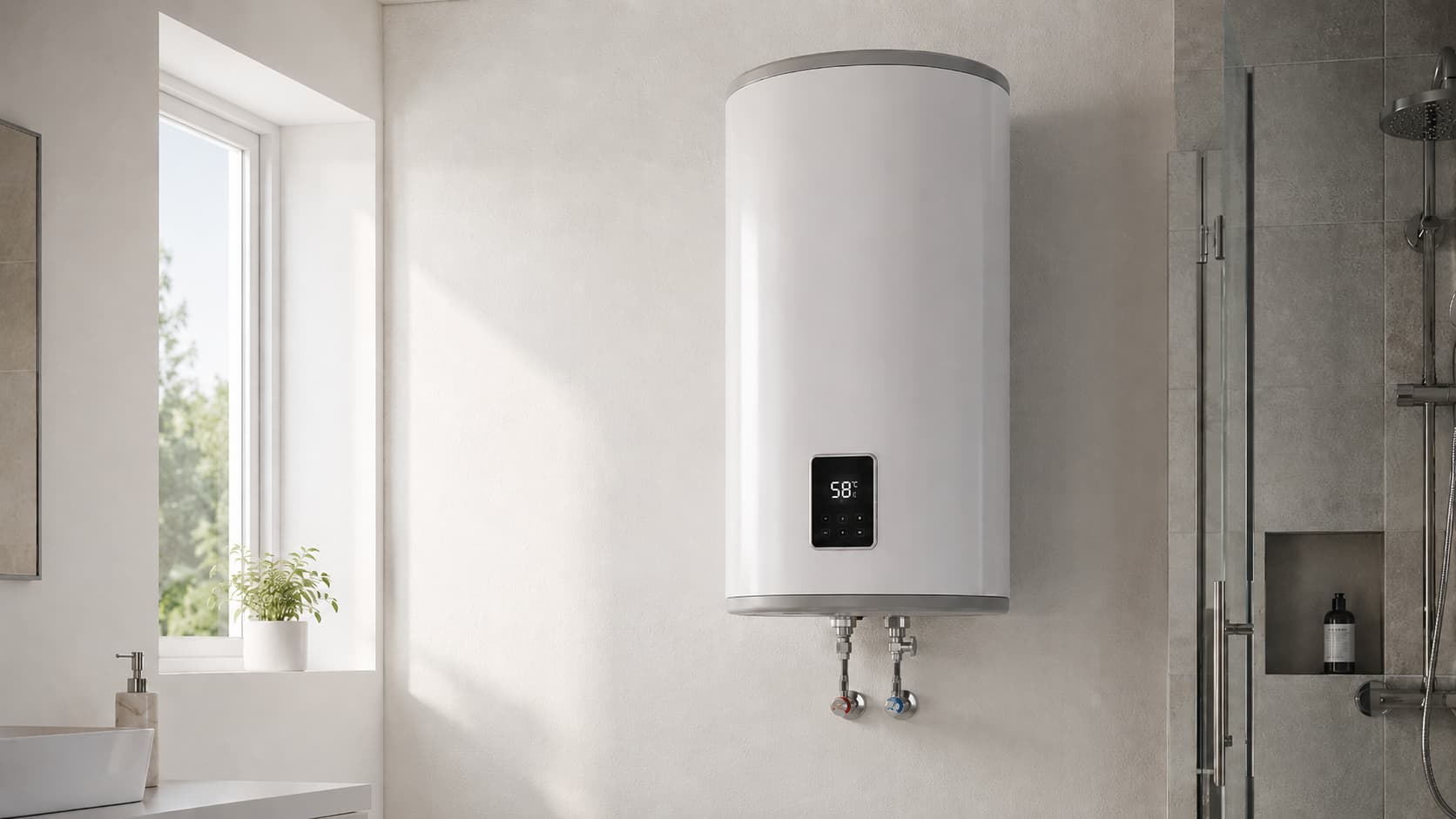
Heating water is one of the largest single uses of energy in a home, often accounting for 15 to 20 percent of the total electricity or gas bill. Most households have no clear idea what their water heater costs to run. This article gives you the numbers, explains what drives the cost up or down, and shows you where the real savings are.
Calculate your water heater running cost
Enter your heater type, daily hot water use and energy price to see your exact daily, monthly and annual cost.
Open Water Heater Cost Calculator →What actually drives the cost
Three factors determine how much your water heater costs to run:
- How much hot water you use. A single person using 50 litres per day pays a fraction of what a family of four using 200 litres pays.
- The temperature rise required. If your cold water supply comes in at 10°C and you heat to 60°C, you are raising the temperature by 50°C. Warmer climates with higher inlet temperatures cost less to heat.
- Your heater type and efficiency. An electric resistance heater is nearly 100% efficient at converting electricity to heat, but electricity is expensive. A heat pump water heater delivers 2.5 to 4 units of heat per unit of electricity. A gas heater is cheaper per kWh of fuel but wastes 10 to 20% up the flue.
Tank size and standing losses matter less than most people expect. A tank may lose around 1 to 3 kWh per day, depending on size, insulation and temperature setting. Your daily hot water draw is typically 5 to 15 kWh. The tank is not the problem. Usage is.
Typical running costs by heater type
The table below uses a household drawing 150 litres of hot water per day, heating from 15°C to 60°C. Electricity and gas prices vary significantly by country, so figures are shown at multiple rates.
| Heater type | Daily kWh | Monthly at $0.15/kWh | Monthly at $0.28/kWh |
|---|---|---|---|
| Electric resistance (90% eff.) | ~8.1 kWh | ~$36 | ~$68 |
| Gas boiler (85% eff.) | ~8.6 kWh gas | ~$10–$32/month (at $0.04–$0.08/kWh gas equivalent) | |
| Heat pump water heater (COP 3.0) | ~2.7 kWh el. | ~$12 | ~$23 |
| Tankless electric (99% eff.) | ~7.4 kWh | ~$33 | ~$62 |
Gas prices vary widely. In the US, residential gas typically runs $0.04 to $0.08 per kWh equivalent. In the UK, around £0.06 to £0.08/kWh. In Germany, around €0.08 to €0.12/kWh. Check your bill for the rate you actually pay.
How to calculate your own cost
The formula is straightforward:
Daily kWh = litres per day × 0.001163 × temperature rise (°C) ÷ efficiency
For example: 150 litres, heating from 15°C to 60°C (a 45°C rise), electric resistance at 90% efficiency:
150 × 0.001163 × 45 ÷ 0.90 = 8.7 kWh per day
At $0.25/kWh, that is $2.18 per day, $65 per month, or $796 per year.
For a tankless heater, the input is flow rate and run time rather than a daily litre figure, but the underlying calculation is the same.
Common mistakes that push costs up
- Temperature set too high. Many systems are set around 60°C to reduce legionella risk. Do not lower the setting without checking local guidance, the heater manual and scalding protection. Setting it above 65 to 70°C wastes energy with no additional safety benefit.
- Long pipe runs without insulation. Hot water sitting in uninsulated pipes loses heat before it reaches the tap. If you run the tap for 30 seconds before hot water arrives, that pre-flush is wasted energy every single time.
- Oversized tank. A 300-litre tank for a two-person household holds water at temperature that is rarely drawn. Standing losses accumulate, and the energy to reheat after partial draws is higher than necessary.
- Old heater past its efficiency rating. Electric resistance heaters degrade in efficiency over time as scale builds on the element. A 15-year-old heater in a hard water area draws measurably more than a new one for the same output.
- Not checking your inlet temperature. Cold water in Nordic or Canadian winters arrives at 4 to 8°C. In southern European or Australian summers, it might be 18 to 22°C. A 14°C difference in inlet temperature changes your annual cost by 25 to 30 percent.
Where the real savings are
Reducing hot water use is the highest-leverage change. Low-flow shower heads cut hot water draw by 30 to 50 percent with no change in comfort for most people. Shorter showers matter more than almost anything else on the heater side.
If your heater is electric resistance and more than 8 to 10 years old, a heat pump water heater is worth serious consideration. The running cost reduction is substantial and the technology has become reliable and affordable in most markets. In some markets, rebates or tax credits may be available. Check current programmes in your country or state before calculating payback.
Pipe insulation on hot water pipes is cheap and recovers the cost within months. In older homes with long pipe runs from the heater to bathrooms or kitchens, this is often the single most cost-effective improvement available.
See how water heating compares to other home electricity uses if you want a broader picture of where your money goes.