Your bathroom floor is warm every morning, and you barely think about the cost. Then you notice the electricity bill is higher than expected. You trace it back to the underfloor heating, and realise you have no idea how much it actually draws. That is a common situation, and the numbers are not always what people expect.
Why the running cost surprises people
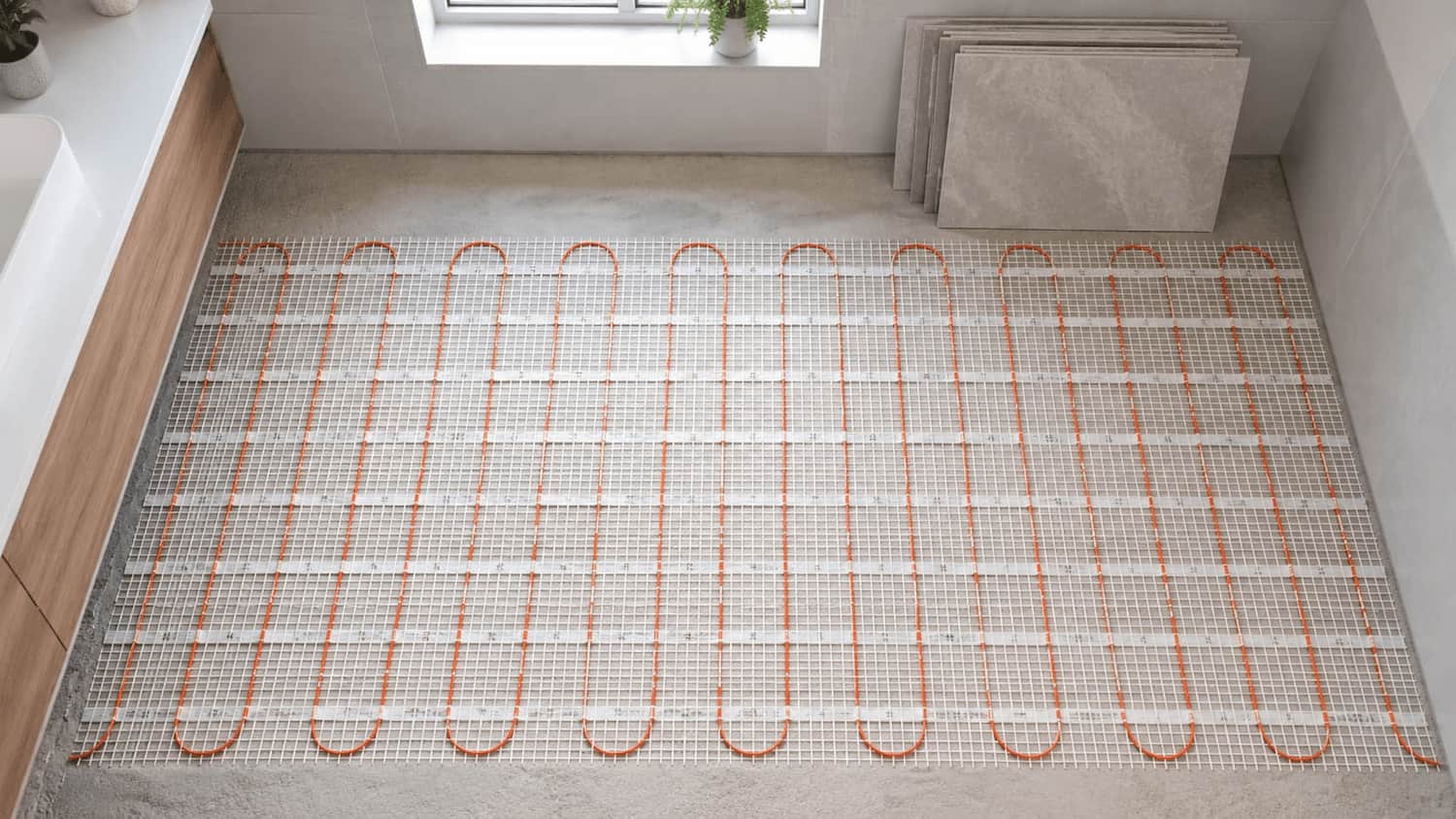
Electric underfloor heating is rated in watts per square metre. A 10 m² floor with a 120 W/m² mat draws 1.2 kW total. Run that for 8 hours and you use 9.6 kWh. At $0.28/kWh, that is $2.69 per day, around $82 per month, and roughly $491 over a 6-month heating season.
Most people estimate far less. The confusion comes from confusing kilowatts with kilowatt-hours. The mat draws 1.2 kW, which sounds modest. But multiply by hours of use and the number grows quickly.
Electricity rates vary significantly by country. In the UK, typical rates run around £0.24–£0.28/kWh. In Germany, around €0.30–€0.40/kWh. In the US, around $0.13–$0.20/kWh. In Australia, roughly AUD $0.25–$0.40/kWh. Use your actual bill rate when calculating your own costs.
How wattage affects what you pay
The wattage of your system per square metre is the biggest variable. Heating foil is typically 100 W/m². Standard mats run at 150 W/m². Cables often reach 160 W/m². A low-output mat at 120 W/m² sits in between.
Here is what 10 m² costs to run for 8 hours per day at $0.28/kWh over a 6-month heating season:
| System type | Typical wattage | Daily cost (10 m², 8h) | 6-month season |
|---|---|---|---|
| Heating foil | 100 W/m² | $2.24 | $409 |
| Low-output heating mat | 120 W/m² | $2.69 | $491 |
| Standard heating mat | 150 W/m² | $3.36 | $614 |
| Heating cable | 160 W/m² | $3.58 | $655 |
These figures assume continuous operation. A thermostat reduces all of them by an estimated 30%. For 20 m² or 30 m², scale proportionally.
A thermostat can save more than you expect
Without a thermostat, your system runs at full power for the entire scheduled window. With one, it cycles on and off to hold the target temperature. That typically reduces effective run time by around 30%, though the actual saving depends on how well-insulated your floor is and how the room is used.
For a 10 m² floor at 120 W/m² over a full heating season, that estimated 30% reduction is roughly $147, bringing the seasonal cost from $491 down to around $344. A decent programmable thermostat costs $30–$80 and can pay for itself within a season.
A thermostat with a floor sensor also protects your floor covering. Many laminate, LVT and engineered wood manufacturers require thermostatic control as a warranty condition. Without it, you may be running outside the permitted temperature range without knowing it.
Your floor covering sets the limit
Tiles and stone tolerate heat well. Other materials are less forgiving. Most laminate, vinyl, LVT and wood floor manufacturers specify a maximum surface temperature, typically in the range of 27–29 °C. Exceeding it can cause warping, gapping or delamination over time.
Heating foil around 100 W/m² is often used under floating floor coverings. It generates less heat per square metre and gives more margin before reaching the surface temperature limit. Under tiles, higher wattages are generally fine.
Mistakes that push the bill up
- No thermostat. Running the system continuously at full power is the single biggest cause of high bills. It is also avoidable.
- Treating 8 hours as actual run time. If you programme the system to run for 8 hours but have a thermostat, the actual active heating time is much shorter. The two numbers are not the same.
- Using electric heating for large open areas. Electric underfloor heating works well for bathrooms, kitchens and entrance halls. For a large living room or whole-home heating, the installed wattage and running costs climb steeply.
- Setting the thermostat to maximum. A lower target temperature usually means lower consumption, and small adjustments can still give acceptable comfort.
- Not checking the floor covering limit before installing. A high-wattage cable under a laminate floor without thermostatic control is both expensive to run and a risk to the floor itself.
How to work out your actual cost
- Measure the heated area. Use the area the mat or cable actually covers. Around bathroom fixtures and furniture, this is often less than the full room area.
- Find your rated wattage. Check the installation guide or product label. If the system is already installed and you do not know the wattage, check the thermostat, installation documents or ask an electrician to measure the circuit load.
- Be honest about usage hours. If you have a thermostat, your effective heating time is 50–70% of the scheduled window, not the full duration.
- Use your actual electricity rate. The figure on your bill is the only one that matters for your calculation.
Calculate your underfloor heating cost
Enter your floor area, heating type, usage hours and electricity rate to see estimated daily, monthly and seasonal running costs.
Open Underfloor Heating Cost Calculator →When electric underfloor heating gets expensive
For a bathroom or kitchen, the numbers are manageable. A 10 m² floor at 120 W/m² with a thermostat costs around $344 per heating season at $0.28/kWh. That is a reasonable comfort cost for a well-used room.
Scale it up and the picture changes. A 100 m² home with 80 m² of electric floor heating at 150 W/m² draws 12 kW at full load. At $0.28/kWh and 10 hours per day over a 6-month season, the theoretical maximum is around $6,100. Even with a thermostat and good insulation, whole-home electric underfloor heating is expensive to run.
For whole-home heating, a water-based system connected to a heat pump is far more cost-effective. Electric systems belong in smaller areas where a few hundred per season is a fair trade for warm floors underfoot.