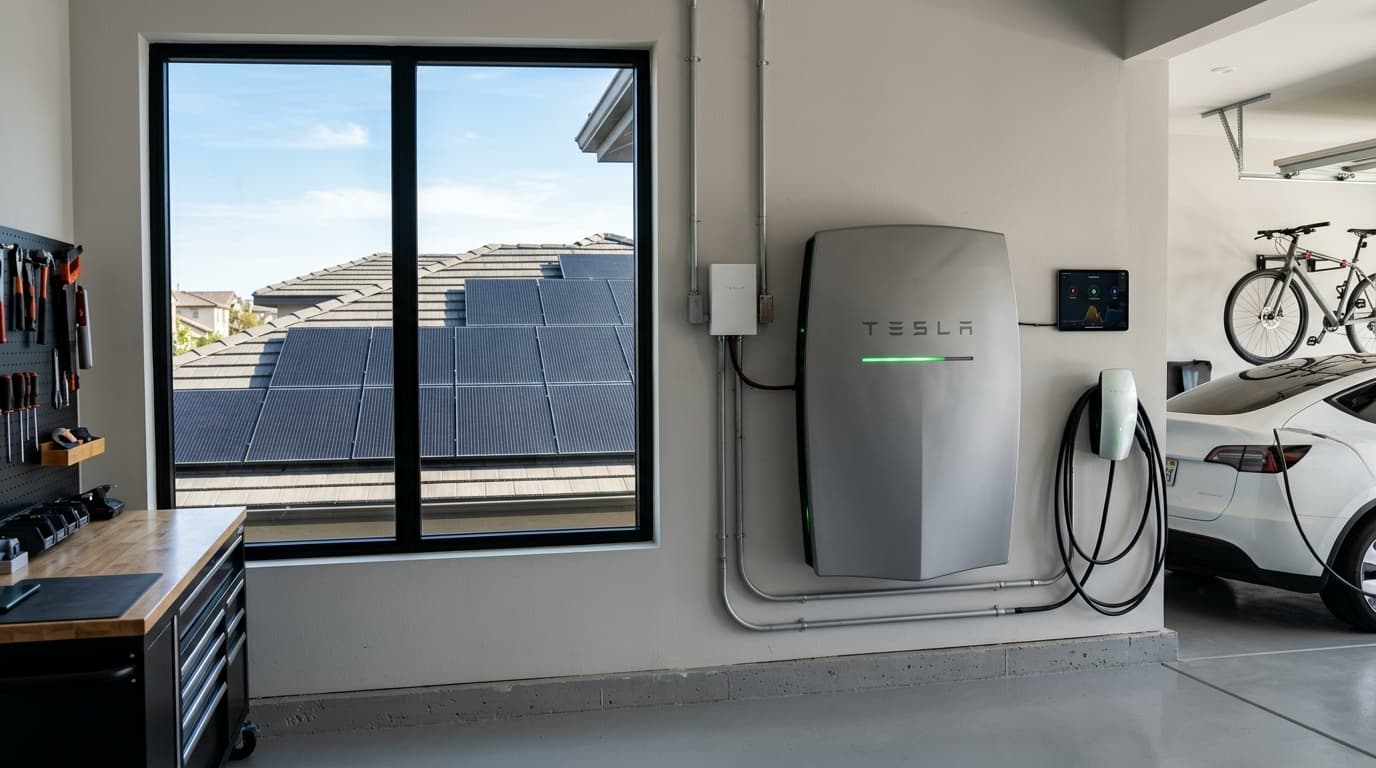
A home battery stores electricity for when it costs more to buy. With solar panels, that means keeping your own generation rather than exporting it at a low feed-in rate. Without solar, it means charging overnight and discharging during expensive peak hours. Whether either approach pays back depends on your local electricity rates, tariff structure, and installed cost.
This article works through the numbers honestly. No best-case projections. The figures you need to decide.
What a home battery does
A home battery stores electricity from solar panels or the grid so you can power your home later, when electricity is more expensive or solar production is lower.
If you have solar panels, a battery stores the surplus generation that would otherwise be exported to the grid at a low export rate or feed-in tariff. You then draw on that stored energy in the evening or at night, avoiding buying electricity at the full retail price.
If you do not have solar panels, a battery charges from the grid at off-peak rates and discharges during the expensive peak hours in the morning and evening. The saving comes entirely from the price difference between those two periods.
Both approaches work. But the numbers are significantly better when solar panels are part of the system.
What a battery system costs
Installed cost varies by country, capacity, inverter setup, installer, and available incentives. The figures below are rough reference ranges. Get quotes from at least two local installers before drawing any conclusions.
| Capacity | Example installed cost ranges | Best suited for |
|---|---|---|
| 5 kWh | USD 4,000–8,000 / GBP 3,500–6,000 | 1 to 2 person household, low evening demand |
| 10 kWh | USD 7,000–14,000 / GBP 6,000–10,000 | Family home, covers most of the evening and night |
| 15 kWh | USD 12,000–20,000 / GBP 9,000–15,000 | Larger home or home with an EV |
Example installed cost ranges. Replace with local market prices. Costs vary significantly by country, brand, installer, and local incentives.
Installation adds to the total if your existing inverter is not battery-compatible. If you are adding a battery to an existing solar system, check inverter compatibility first. Replacing an incompatible inverter adds significantly to the overall cost. Confirm this in writing before signing any contract.
With solar panels: where the savings come from
Most households with solar panels export between 30% and 60% of their annual generation. Without a battery, that exported electricity earns the local export rate or feed-in tariff, which is often well below the retail import price. A battery lets you store that surplus and draw on it in the evening instead.
Your saving per unit stored is the difference between your local retail import rate and the export rate you would otherwise receive. If your import rate is 0.25 per kWh and your export rate is 0.06 per kWh, each kWh stored and self-consumed saves 0.19. At 0.15 export and 0.25 import, the saving is 0.10 per kWh. Check your actual export rate and import rate before running any numbers.
A 4 kWp solar system generates roughly 3,000 to 5,000 kWh per year depending on your location and climate. If 50% is exported, a battery lets you self-consume most of that instead, reducing how much electricity you buy from the grid.
If you are on a time-of-use tariff, charging the battery at off-peak rates overnight adds further savings on top of solar self-consumption.
Without solar panels: a harder case
Without solar, savings come entirely from buying off-peak electricity at a lower rate and discharging during expensive peak periods. This requires access to a time-of-use tariff.
The price spread between off-peak and peak rates varies widely by country and supplier. A consistent spread of 0.15 per kWh on a 10 kWh battery cycling once daily would generate around 550 per year in theory. In practice, the battery does not run at full capacity every day, and tariff structures differ. A realistic annual saving from tariff arbitrage alone is typically 40 to 70% of the theoretical maximum.
Without solar, the financial case depends mainly on the price gap between off-peak and peak electricity in your market. In markets with a large spread, a battery may still pay back. In markets with a flat or small spread, it is unlikely to.
Payback period: what to expect
| Scenario | Main saving driver | Financial case | What to check first |
|---|---|---|---|
| Solar + low export rate | Gap between import and export rate | Good | Your current export or feed-in rate |
| Solar + high self-consumption | Avoiding peak grid imports | Best case | How much solar you currently export unused |
| No solar + time-of-use tariff | Off-peak/peak price spread | Moderate | Size of your tariff spread and daily cycling flexibility |
| No solar + flat tariff | None | Weak | Switch tariff before considering a battery |
In many markets, home battery payback often falls somewhere between 8 and 15 years when paired with solar panels and favorable tariffs. Without solar, payback is usually longer unless the off-peak and peak price gap is large. These are general indications. Actual payback varies by market, installer, and household consumption.
Payback depends on your local electricity rates, the installed cost in your market, and whether local grants or rebates apply. Enter your own numbers in the calculator below for a personalised estimate.
Common mistakes when buying a battery
Buying a battery before checking your inverter. Many older solar inverters are not battery-ready. Adding a compatible hybrid inverter to an existing system adds cost and complexity that some installers fail to mention upfront.
Choosing capacity based on solar panel output, not household demand. The right battery size matches your evening and overnight consumption, not your peak solar generation. A large solar array with a small household demand profile needs a modest battery, not a large one.
Assuming you will cycle the battery every day. In winter, a solar battery charges less because generation is low. In summer, it charges more. Annual average cycling is typically 250 to 300 full cycles per year in most climates when solar-charged, not 365.
Ignoring the tariff. A battery on a flat-rate tariff saves far less than one paired with a time-of-use tariff. Switching tariff at the same time as installing the battery is one of the highest-impact decisions you can make.
Expecting backup power by default. Most home batteries do not provide backup power during a grid outage unless you specifically buy a system with islanding capability. Check before you buy if backup power matters to you.
How to pick the right size
Start with your evening electricity consumption. Look at your smart meter data or energy bills and find your average draw between 4pm and 11pm. That figure, in kWh, is roughly the battery capacity you need.
For most households, that is between 4 and 8 kWh. A 10 kWh battery gives you headroom for higher-demand days, an EV top-up, or overnight draw as well.
Going larger than 15 kWh rarely makes financial sense for a single-family home without a large EV fleet or unusually high energy consumption.
How to check if a battery pays back for you
Before contacting an installer, gather these five numbers. They determine whether a battery makes financial sense for your situation.
- Installed battery cost. Get at least two quotes. Ask the installer to break out hardware and labour separately, and whether the quote includes inverter replacement if needed.
- Your electricity import rate. Check a recent bill for the rate you pay per kWh. If you are on a time-of-use tariff, note the peak and off-peak rates separately.
- Your export rate or feed-in tariff. If you have solar panels, find what you earn per kWh exported to the grid. This is often shown on your bill or in your energy account.
- Estimated daily cycling. A battery cycling once per day at 10 kWh stores 3,650 kWh per year. In practice, solar batteries average 250 to 300 full cycles per year. Adjust for your climate and solar system size.
- Compare annual saving against battery lifetime. Multiply your daily saving by 365, then divide the net installed cost by the annual saving. If payback exceeds the warranty period, wait for prices to fall further or check for available grants.
Calculate your home battery payback
Enter your electricity rate, export rate, battery cost, and expected cycling to get a payback estimate based on your situation.
Open Battery CalculatorIf you want a more detailed breakdown, including grid arbitrage mode, battery degradation and an optional replacement at year 10, the Home Battery Payback Calculator runs the same numbers with a full year-by-year model.
Battery prices have fallen steadily for several years. If your payback period is currently 18 years or more, waiting two to three years may make sense. The exception is if you are installing solar panels now: adding a battery at the same time reduces installation costs, because the labour and electrical work overlaps. Run your numbers in the calculator, then get at least two installer quotes before committing.